
Assess the price-to-quality ratio of cookware by comparing purchase price with construction, cooking performance, expected service life, care demands, and replacement risk. Check the pan’s base thickness, material quality, handle attachment, lid fit, oven compatibility, and warranty before comparing prices. A low-cost pan may be poor value if it warps, loses its finish, or requires replacement quickly, while an expensive piece earns its price only when its durability and performance match your cooking habits. Compare similar sizes and materials, calculate an approximate cost per year, and judge whether the pan solves a real kitchen need rather than paying for excess pieces or branding.
Define Value Before Comparing Prices
The price-to-quality ratio of cookware is not a simple contest between the cheapest and most expensive products. Value comes from the useful cooking performance, durability, safety features, and convenience you receive for the money spent. A $40 skillet used several times a week may offer better value than a $15 skillet that becomes uneven or unusable within a short period. An expensive stockpot, on the other hand, may be poor value if its capacity exceeds your needs and spends most of its life in a cabinet.
Begin by identifying the job the piece must perform. A saucepan used for oatmeal, sauces, and reheating needs a stable base, a comfortable handle, and a lid that fits well. A sauté pan used for browning meat and reducing sauces benefits from responsive heat control, a broad cooking surface, and enough depth to contain liquid. Comparing those pieces only by brand reputation or coating label ignores the features that affect everyday results.
Some suggestions to consider!
Now retrieving an image set.
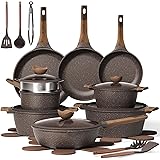
CAROTE 26pcs Pots and Pans Set Non Stick Cookware Sets | Induction Kitchen Cooking Set, Special Texture Design, Ultra Durable, Easy Food Release, Even Heating, with Frying Pans Set
$139.99 (as of October 14, 2026 19:08 GMT +00:00 - More infoProduct prices and availability are accurate as of the date/time indicated and are subject to change. Any price and availability information displayed on [relevant Amazon Site(s), as applicable] at the time of purchase will apply to the purchase of this product.)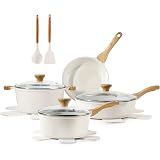


SENSARTE Nonstick Ceramic Cookware Set, 13-pcs Non-toxic Pots and Pans Set | Healthy Kitchen Cooking Set with Stay-Cool Handles, Silicone Tools and Pot Protectors, PFAS Free
$65.94 (as of October 14, 2026 19:08 GMT +00:00 - More infoProduct prices and availability are accurate as of the date/time indicated and are subject to change. Any price and availability information displayed on [relevant Amazon Site(s), as applicable] at the time of purchase will apply to the purchase of this product.)
Now retrieving an image set.
HexClad Hybrid Nonstick 6 Pc Pot Set & Trivets, 2, 3, and 8-Qt Pots & Lids | Stay-Cool Handles, Dishwasher and Oven Safe, Compatible with All Cooktops, Induction REady
$379.00 (as of October 14, 2026 19:08 GMT +00:00 - More infoProduct prices and availability are accurate as of the date/time indicated and are subject to change. Any price and availability information displayed on [relevant Amazon Site(s), as applicable] at the time of purchase will apply to the purchase of this product.)Write down the meals and techniques that matter most, then rank the required characteristics. A home cook who makes delicate eggs may place release performance and gentle heat control first. Someone who sears frequently may prioritize a durable cooking surface and strong heat retention. This use-based approach also prevents a common mistake: buying a large set because the per-piece price looks attractive, even though several included items duplicate one another or rarely fit your routine.
Useful value questions include:
- Will this piece be used often enough to justify its cost?
- Does its construction suit the cooktop, oven, and recipes involved?
- Can the finish and hardware withstand the care you are realistically willing to provide?
- Would one better-made pan replace two mediocre pieces?
For additional context, compare these decisions with how to assess the price-to-quality ratio of cookware as a use-case question, not merely a shopping question. The strongest purchase is usually the one that matches a specific cooking workload.
Inspect Construction And Cooking Performance
Construction provides the clearest connection between price and real performance. Examine the cooking base, wall thickness, handle attachment, rim, lid, and interior finish rather than relying on a product’s weight or marketing language alone. A heavier pan is not automatically better; excessive weight can make pouring, lifting, and washing inconvenient. What matters is whether the material is distributed in a way that supports stable heating and reliable handling.
Look for a base that sits flat on a level surface and makes consistent contact with the burner. A well-designed base can reduce hot spots and help food brown more evenly, while a poorly formed or thin base may react sharply to heat changes or develop distortion. On induction cooktops, confirm that the manufacturer identifies the piece as compatible; a magnetic base alone does not tell you how evenly it will heat.
Handles deserve a hands-on assessment when possible. A handle should feel secure, provide enough clearance from the cooking surface, and remain practical for the pan’s likely weight. Riveted handles can be robust, but the rivets may create areas that require extra cleaning. Welded handles may offer a smoother interior, but the quality of the attachment still needs inspection. Check whether the lid sits neatly, whether the knob is firmly attached, and whether steam escapes in a way that suits the intended cooking task.
Material comparisons should be specific. Stainless steel may tolerate high heat and utensil contact well, but food release depends heavily on technique and preheating. Nonstick cookware can simplify low-fat cooking and cleanup, yet its surface typically demands more careful heat and utensil choices. Cast iron can provide strong heat retention, although its weight and maintenance requirements make it less convenient for some users. Aluminum may heat quickly, but the design and protective finish determine how it performs over time.
A useful test is to compare two similar pans while asking what the added price actually buys. If the costlier model has a flatter base, stronger handle, better lid, and clearer care instructions, the premium may be defensible. If it mainly adds decorative branding while using comparable construction, the ratio is weaker. Avoid the misconception that a prestigious label automatically proves better cooking results.
Calculate Durability, Care, And Lifetime Cost
Expected service life changes the meaning of the sticker price. A practical estimate divides the purchase cost by the years of useful service, then considers whether the pan remains pleasant and effective throughout that period. This is not a precise financial forecast because usage, storage, heat settings, and cleaning habits vary, but it exposes misleading bargains. A $25 pan that lasts two years has a very different cost profile from a $75 pan that remains reliable for eight years.
Durability depends on more than the main material. Repeated thermal shock can stress cookware, sudden temperature changes can contribute to warping, and rough storage can damage finishes or rims. A coating may perform well when used within its heat and utensil limits but deteriorate quickly when exposed to aggressive scrubbing or excessive temperatures. A pan that is technically durable but difficult to clean may be abandoned before it physically fails, which still reduces its practical value.
Read the care instructions before purchase, especially when comparing dishwasher-safe claims, oven limits, seasoning requirements, and restrictions on metal utensils. “Dishwasher safe” does not mean every cycle or detergent will preserve the appearance indefinitely, and “oven safe” may apply only to a particular temperature or exclude the lid and handle. A product with a simple care routine may be worth more to a busy household than a technically robust piece requiring frequent maintenance.
Use a compact lifetime-cost check:
- Record the full purchase price, including necessary lids or accessories.
- Estimate realistic years of satisfactory service rather than optimistic maximum life.
- Note replacement parts, special cleaners, seasoning supplies, or likely companion pieces.
- Reduce the value rating if care demands conflict with your normal routine.
Consider a coated skillet purchased for daily eggs. Its value is strong when the surface releases food reliably, the owner avoids damaging heat and utensils, and the replacement interval fits the expected use. A stainless skillet may cost more to use successfully at first because technique matters, but its resistance to surface wear may make it the better long-term choice for high-heat tasks. Neither option wins universally; the better ratio depends on the work assigned to the pan.
Warranty terms can provide useful information about manufacturer confidence, but they should not be treated as a guarantee of hassle-free ownership. Check what defects are covered, how claims are handled, and whether ordinary wear is excluded. A vague warranty should not compensate for visibly weak construction.
Compare Like With Like And Avoid Pricing Traps
Cookware prices become meaningful only when the compared products have similar roles, dimensions, materials, and included components. A 10-inch frying pan should be compared with other 10-inch frying pans, not with a larger pan from a different construction category. Set pricing can also hide differences: one package may include three frequently used pieces, while another counts lids, trivets, or tiny accessories as separate items.
Normalize the comparison by recording size, usable capacity, material, base design, coating, lid inclusion, handle configuration, cooktop compatibility, oven limit, and care requirements. Then assess the features that matter to your stated use. A pan that is cheaper per item but too shallow for sauces or too heavy for regular lifting is not a bargain for that household.
Promotional pricing creates another trap. A temporary discount may be worthwhile, but a crossed-out “original” price does not establish quality. Product descriptions can also use broad phrases such as professional, premium, or heavy duty without explaining thickness, construction, or testing. Look for precise specifications and consistent details across the manufacturer’s documentation. Missing information is not proof of poor quality, but it lowers confidence and should restrain the price you are willing to pay.
Brand reputation can reduce uncertainty, yet it should support—not replace—inspection. Established companies can sell both excellent and ordinary lines, while lesser-known manufacturers may offer sound construction but weaker support. User reviews are most useful when they describe specific outcomes such as base stability, handle looseness, coating wear, lid fit, or cleaning difficulty. Give less weight to reviews that only praise appearance or report a few days of use.
Compare a premium individual pan with a budget set under the same cooking scenario. If the individual pan is used four times weekly and the set’s remaining pieces are rarely touched, the single piece may produce greater value. If a household needs several coordinated sizes and the set provides matching lids, compatible construction, and no major duplicates, the set may be sensible. The failure mode is allowing the discount percentage to decide before the cooking workload does.
Use A Practical Cookware Buying Checklist
A short, repeatable process makes price-to-quality judgments more consistent. First, select the cooking task and size; then eliminate products that fail basic compatibility requirements. A beautifully finished pan that cannot be used on your cooktop or safely stored in your kitchen is not a high-value purchase.
Next, inspect the physical and written evidence. Check that the pan sits flat, the handle does not wobble, the rim is even, and the lid fits without excessive movement. Confirm the actual oven limit, care instructions, included accessories, and warranty terms. For online purchases, use detailed manufacturer specifications and return policies to compensate for the lack of hands-on inspection.
In summary, score each remaining option against the factors that affect your routine. You might rate cooking performance, construction, durability, ease of care, compatibility, and price from one to five, while giving extra weight to the first two or three categories. Do not let a low price rescue a product that fails a non-negotiable requirement such as induction compatibility or a secure handle.
Signs of a promising purchase include stable contact with the cooktop, clear specifications, appropriate capacity, secure hardware, and care instructions you can follow without changing your entire routine. Warning signs include a visibly uneven base, unexplained material claims, loose fittings, a coating with unclear limitations, or a set padded with unwanted pieces. Paying slightly more for a frequently used item can be rational; paying more for unused capacity or decorative features usually is not.
Keep a simple record after purchase. Note how evenly the pan heats, how it handles cleanup, whether the handle remains secure, and whether the surface changes under normal use. That experience becomes more valuable than generalized rankings when you later decide whether to buy the same line again. If you want to refine the comparison, revisit how to assess the price-to-quality ratio of cookware after several months of actual use, when ownership costs are easier to judge.
For product-specific limits and care requirements, consult the manufacturer’s official documentation before purchase and retain it for reference. Cookware materials behave differently under heat, cleaning, and storage conditions, so the maker’s instructions are more useful than a generic claim about an entire material category.
Frequently Asked Questions
Does a higher cookware price usually mean higher quality?
Not necessarily. A higher price may reflect stronger construction, better hardware, or longer support, but it can also reflect branding or design. Compare specifications and use-case performance.
How can I compare a cookware set with individual pieces?
Count only the pieces you will regularly use, compare equivalent sizes and materials, and include lids, storage needs, and replacement costs in the calculation.
Which construction details deserve the most attention?
Check a flat base, secure handle attachment, suitable wall and base construction, a well-fitting lid, clear compatibility information, and care instructions that match your routine.
Is lightweight cookware automatically lower quality?
No. Lightweight cookware can be convenient and responsive. Judge whether it heats evenly, stays stable, resists distortion, and remains comfortable for the intended task.
What is the simplest way to estimate long-term value?
Divide the purchase price by realistic years of satisfactory service, then adjust for special care, accessories, replacement risk, and how often the piece will be used.
Conclusion
A reliable cookware value judgment connects price with the work a piece must perform, not with its label or discount alone. Match the pan or pot to your recipes, inspect the base and hardware, verify cooktop and oven compatibility, and read care requirements before comparing the final prices. Estimate useful service life rather than assuming the cheapest option costs less over time, and treat sets cautiously when they include pieces you will rarely use. A premium is reasonable when it buys stable heating, dependable construction, easier ownership, or a longer useful life. Before purchasing, compare two or three similar options using the same checklist and choose the one whose measurable qualities fit your kitchen most closely.