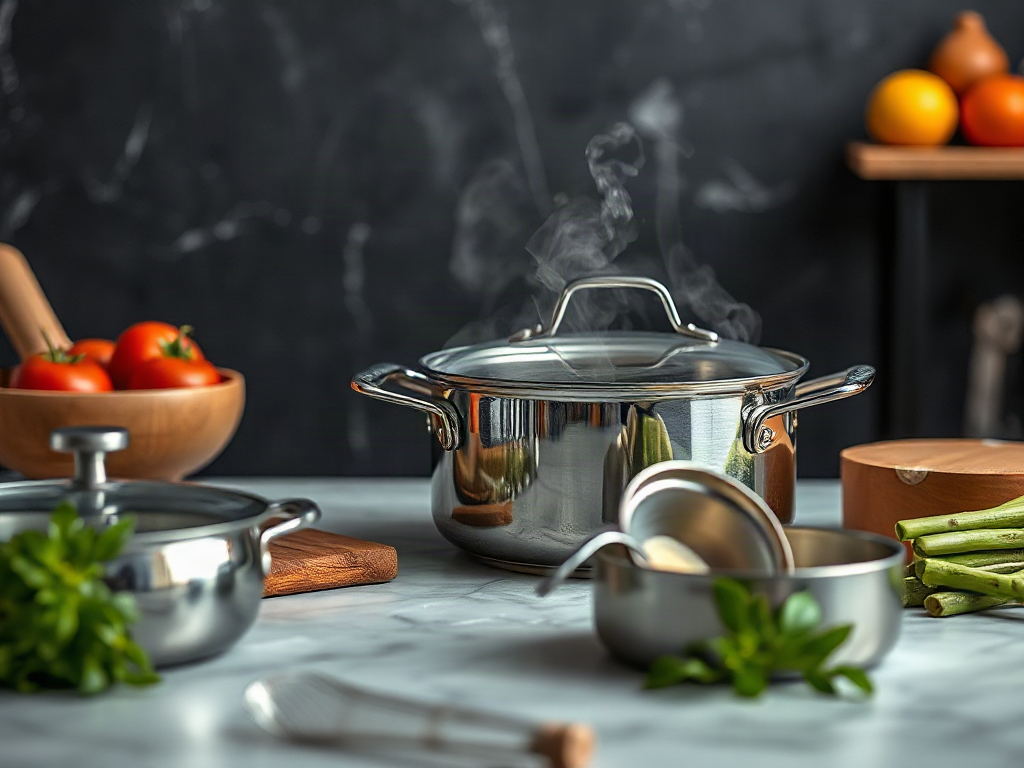
Cookware with built-in thermometers improves temperature awareness by showing heat conditions without requiring a separate handheld tool, which can make simmering, roasting, frying, and covered cooking more repeatable. The display helps cooks notice overheating, adjust burner or oven settings sooner, and maintain steadier conditions for temperature-sensitive foods. Its usefulness depends on what the sensor measures: lid, vessel, oil, water, and food temperatures are not interchangeable. For reliable results, verify the reading against a trusted thermometer, account for sensor placement and response delay, and continue checking the internal temperature of meat and other safety-sensitive foods with an appropriate food thermometer.
How Do Built-In Thermometers Improve Temperature Control?
A visible temperature reading turns heat adjustment into a measured decision rather than a reaction to smoke, aggressive bubbling, or scorched food. Standard cookware leaves the cook to infer conditions from sound and appearance. Those cues remain useful, but they often appear after the vessel has already become hotter than intended. An integrated gauge can reveal the upward trend early enough to lower the burner, uncover the pot, or move the pan from the heat.
Some suggestions to consider!
Now retrieving an image set.
SENSARTE 17 Piece Nonstick Detachable Handle Pots and Pans Set Black | Removable Handle Cookware Set, Induction Cookware Set with Removable Handle, Healthy Non Stick for RV, Dishwasher & Oven Safe
$79.99 (as of October 24, 2026 19:20 GMT +00:00 - More infoProduct prices and availability are accurate as of the date/time indicated and are subject to change. Any price and availability information displayed on [relevant Amazon Site(s), as applicable] at the time of purchase will apply to the purchase of this product.)
Now retrieving an image set.
Redchef Ceramic Pots and Pans Set Non Stick, Detachable Cookware Set 5 Pcs | Non Toxic Induction Compatible, Dishwasher & Oven Safe, Space Saving, PTFE Free, Camping/RV/Traveling, Reliable Gift
$39.99 (as of October 24, 2026 19:20 GMT +00:00 - More infoProduct prices and availability are accurate as of the date/time indicated and are subject to change. Any price and availability information displayed on [relevant Amazon Site(s), as applicable] at the time of purchase will apply to the purchase of this product.)
Now retrieving an image set.
CAROTE 25pcs Ceramic Cookware Set, Detachable Handle Pots and Pans, Green | Non-Stick, Non-Toxic, PFAS Free, Induction Compatible, Dishwasher & Oven Safe, Kitchen Organization, for Camping/RV/Gifts
$99.98 (as of October 24, 2026 19:20 GMT +00:00 - More infoProduct prices and availability are accurate as of the date/time indicated and are subject to change. Any price and availability information displayed on [relevant Amazon Site(s), as applicable] at the time of purchase will apply to the purchase of this product.)The practical gain is consistency. A burner setting does not represent a fixed cooking temperature: output varies among stoves, while pan material, vessel diameter, food quantity, and starting temperature change how quickly heat accumulates. A heavy pot filled with chilled stew responds differently from an empty lightweight pan, even when both sit over the same flame. Watching the actual reading helps a cook establish repeatable conditions instead of assuming that “medium” produces the same result every time.
Consider a covered braise that should cook gently. Steam trapped by the lid can make the contents boil harder than expected, toughening exposed meat and reducing the sauce too quickly. A lid-mounted dial may show that heat inside the vessel continues to rise after the burner is reduced. That feedback encourages smaller, earlier adjustments. The cook still needs to look at the liquid, but the gauge provides another signal without repeatedly lifting the lid and releasing heat and moisture.
Built-in monitoring can also reduce unnecessary intervention. Removing a lid, opening an oven, or inserting a handheld probe repeatedly disturbs the cooking environment. A readable gauge lets the cook track changes from outside, which is especially convenient for stovetop smokers, roasting lids, stockpots, and deep vessels. It does not make the process automatic; it simply makes changes easier to observe.
The common mistake is treating a target reading as a universal recipe instruction. The number is meaningful only when the cook knows where the sensor sits and what it measures. Practical success looks like stable readings paired with the expected visual cues: a controlled simmer, steady steam, or oil that is hot without smoking. If the displayed temperature climbs while the food behaves differently than expected, verify the gauge before changing the recipe.
Which Cooking Tasks Benefit Most?
Temperature-equipped cookware offers the greatest value when a dish needs sustained heat within a useful range rather than a brief burst of maximum heat. Long, covered cooking is a strong use case because the gauge lets the cook monitor the vessel without releasing steam. Soups, stocks, stews, braises, steamed dishes, and stovetop smoking can all benefit from seeing whether conditions are holding steady or drifting upward.
Oil-based cooking may also become easier, provided the sensor actually reaches the oil or the product is designed to estimate oil temperature. Oil can move from insufficient heat to smoking more quickly than an inexperienced cook expects. A compatible built-in thermometer helps identify when the oil has recovered after food is added. That matters because a large batch can cool the oil sharply, leading to pale or greasy results, while excessive heat can darken the coating before the center is cooked.
Baking and roasting vessels with integrated probes serve a different purpose. Some measure the air beneath a lid; others place a probe in the food. A probe that reaches the center of a roast can show progress without frequent oven-door opening. A lid gauge, by contrast, describes the cooking environment and cannot confirm that the center of poultry, meat, or a casserole has reached an appropriate internal temperature. For safety-sensitive foods, a separate food thermometer may still be needed to check the coldest or thickest area.
These products are less valuable for fast techniques governed mainly by surface behavior. Sautéing sliced vegetables or searing a thin cut often depends on preheating, moisture release, browning, and timely movement. A sensor mounted in a lid has little relevance when the lid is not used, while a slow-reacting dial may lag behind rapid pan changes. Experienced cooks may prefer an instant-read or infrared tool for those jobs, depending on whether they need food temperature or surface temperature.
A simple use-case priority helps prevent buying a feature that will rarely matter:
- High value: covered simmering, braising, steaming, stovetop smoking, deep-frying with an oil-contact sensor, and probe-monitored roasting.
- Moderate value: candy making or preserving only when the device has the required range, accuracy, and sensor position.
- Lower value: quick sautéing, high-heat searing, and dishes judged primarily by texture or browning.
Choose according to the process used most often. A cook who prepares weekly stews may benefit from a lid gauge, while someone who mainly sears and stir-fries will probably gain more from responsive cookware and a separate thermometer. The feature earns its space when it measures the temperature relevant to the food, not merely because a dial is present.
What Does the Temperature Reading Actually Mean?
A thermometer reading is local, not a complete map of the vessel. The sensor reports conditions at or near its tip. A probe immersed in frying oil measures something different from a dial mounted high in a lid, and neither necessarily represents the temperature at the center of a thick piece of food. Understanding that distinction is central to using thermometer-equipped cookware well.
Sensor placement explains many apparent contradictions. In a covered pot, air and steam near the lid can be hotter or cooler than food at the bottom depending on evaporation, circulation, and burner intensity. In a roasting pan, hot air around the food changes faster than the center of a large roast. In a multi-layer pan, the cooking surface may react before a gauge located elsewhere. The displayed number should therefore be interpreted alongside bubbling, steam output, browning, texture, and cooking time.
Response speed matters too. Analog dials and protected sensors usually need time to register a change. If the burner is raised sharply, the pan surface or liquid near the base may heat before the needle catches up. Constantly changing the control to chase the dial can create a cycle of overshooting and overcorrecting. A better method is to make a modest adjustment, allow the vessel and sensor to respond, and then reassess.
| Sensor Location | Likely Measurement | Best Interpretation | Main Limitation |
|---|---|---|---|
| Lid-mounted dial | Air or steam near the lid | Track covered cooking conditions | Does not show food-center temperature |
| Immersion probe | Liquid or oil near the probe tip | Monitor simmering, frying, or sugar work | Position and minimum depth affect readings |
| Food probe | Temperature at the inserted tip | Follow internal progress in thick foods | Incorrect placement can miss the coldest area |
| Vessel-mounted sensor | Temperature near part of the cookware body | Compare preheating and heat trends | May not equal the cooking-surface temperature |
Accuracy should not be assumed indefinitely. Impact, repeated heating, moisture intrusion, and normal wear may shift a gauge. Compare it periodically with a reliable thermometer under equivalent conditions, following the manufacturer’s testing and calibration instructions when available. Avoid declaring one device inaccurate when the two sensors are measuring different locations.
A failing setup shows a persistent mismatch between the display and observable conditions, a needle that sticks, condensation inside the dial, or readings that do not change when heat changes. Stop relying on that gauge until it has been checked. The correct response is verification, not compensating with an arbitrary offset that may vary across the temperature range.
Choosing and Using Thermometer-Equipped Cookware
The best purchase matches sensor design to the intended cooking task. Begin by identifying whether the priority is monitoring vessel heat, enclosed air, liquid, oil, or the interior of food. Product descriptions sometimes emphasize a wide temperature scale while giving little information about the point being measured. Sensor location and immersion depth are usually more consequential than an impressive maximum reading.
Readability affects everyday usefulness. A dial should be visible from the normal cooking position, with markings that can be distinguished through steam and typical kitchen lighting. Digital displays may be easier to read and may offer alerts, but they introduce batteries, electronic seals, and temperature limits for detachable components. Analog gauges avoid batteries, although small scales and slower response can make precise adjustments difficult.
Construction still deserves priority over the thermometer. Examine the vessel’s base, handle security, lid fit, weight, stovetop compatibility, and oven-safe limits. A gauge does not compensate for severe hot spots, an unstable pot, or a handle that becomes difficult to control. Also check whether the thermometer assembly can be removed for washing and whether the manufacturer permits dishwasher use. Water trapped inside a dial can impair readability and reliability.
Before relying on new cookware for a demanding dish, run a low-risk comparison. Heat water in the vessel, allow the reading to stabilize, and compare it with a suitable known-good thermometer placed close to the built-in sensor without touching the pan. Follow the maker’s instructions because some lid gauges are not intended to be submerged or tested like immersion probes. The aim is to understand response and placement, not to force unlike instruments to display an identical number.
Use this compact pre-purchase and setup checklist:
- Confirm exactly what medium the sensor measures and where its tip is located.
- Check the useful temperature range against the intended task.
- Review oven, broiler, induction, dishwasher, and lid restrictions.
- Make sure the display remains readable during normal use.
- Determine whether the thermometer can be calibrated, replaced, or removed for cleaning.
- Compare its reading before using it for temperature-sensitive or safety-critical decisions.
Built-in designs trade flexibility for convenience. A separate instant-read thermometer can be moved among pans and inserted into multiple parts of food, while an integrated unit is always available and harder to misplace. The integrated option suits cooks who repeat the same covered, liquid-based, or probe-monitored methods. A separate tool is often better for varied techniques or for checking several locations quickly.
Good operation combines the display with sensory evidence. Record the range associated with a gentle simmer in that specific pot, notice how far the temperature drops after adding ingredients, and allow time for recovery. If the food scorches while the gauge appears normal, reduce heat and investigate sensor placement rather than trusting the number over the result. The thermometer should sharpen judgment, not replace it.
Conclusion
An integrated temperature display is most valuable when it measures the part of the cooking process that needs control. Lid gauges suit covered dishes, immersion sensors suit compatible liquids or oils, and food probes are better suited to tracking internal doneness. Before buying, prioritize sensor position, readable markings, response time, cleanability, and the cookware’s underlying construction.
Treat the reading as one source of evidence rather than an automatic verdict. Verify a new gauge, learn how it behaves in the vessel, and combine it with visible simmering, steam, browning, texture, and an appropriate food thermometer when safety is involved. If the sensor aligns with the cooking method, it can reduce guesswork and make repeated recipes easier to manage. If it measures the wrong location, a separate thermometer will be the more flexible and informative choice.
Frequently Asked Questions
Are built-in cookware thermometers accurate?
They can be sufficiently consistent for monitoring heat trends, but accuracy varies by sensor quality, placement, age, and calibration. Compare the unit periodically with a reliable thermometer under equivalent conditions.
Can a lid thermometer measure the internal temperature of meat?
No. A lid gauge generally measures air or steam near the lid. Use a food thermometer inserted into the appropriate part of the meat to assess its internal temperature.
Is thermometer-equipped cookware useful for deep-frying?
It is useful only when the sensor is designed and positioned to measure oil within the required range. A lid-mounted gauge or vessel sensor may not represent the oil temperature accurately.
Can cookware with an integrated thermometer go in the oven?
Only if the manufacturer identifies the vessel, lid, sensor, handles, and display as oven-safe at the intended temperature. The thermometer may have a lower limit than the pan itself.
How should a built-in thermometer be cleaned?
Follow the product instructions. Avoid submerging non-waterproof dials or electronic parts, clear residue from exposed probes gently, and dry the assembly promptly to reduce moisture intrusion.