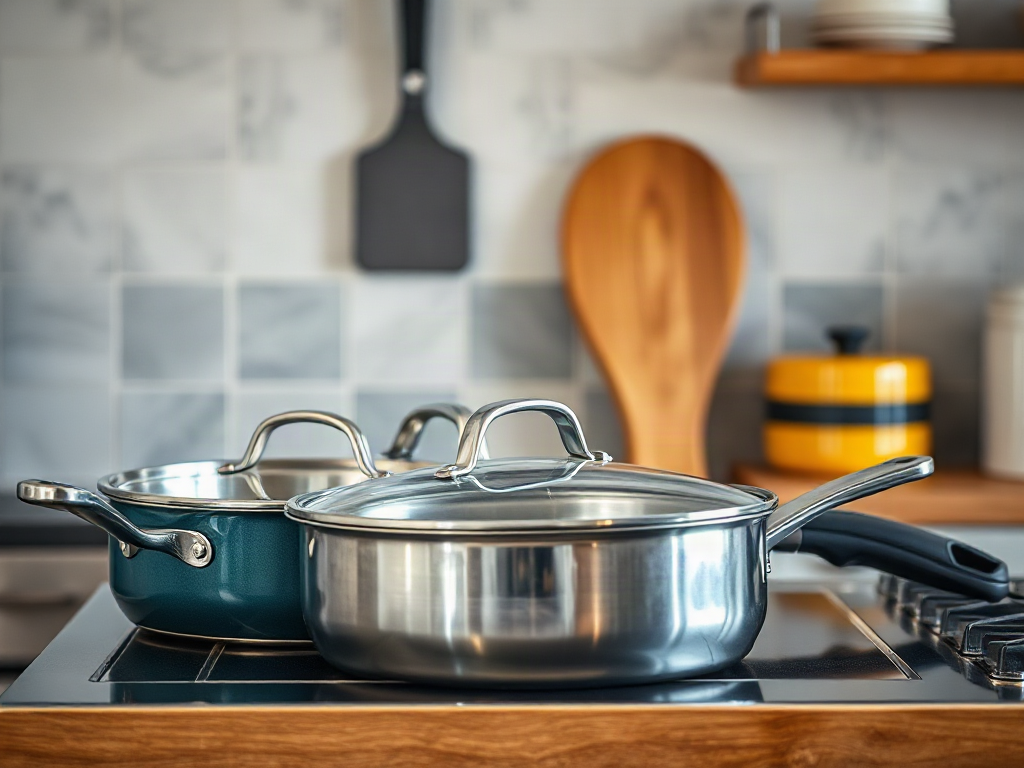
To spot cookware that doesn’t warp, inspect the base for flatness, choose a sufficiently thick and well-bonded construction, and check the maker’s guidance for stovetop compatibility and thermal-shock limits. Set the pan on a truly flat surface and look for rocking, gaps, or a lifted center; then examine whether the base is reinforced rather than merely decorated. Thick-gauge aluminum, stainless steel with a bonded core, and heavy cast iron generally resist shape changes better than thin, lightweight pans, although each has different handling tradeoffs. Avoid rapid temperature changes, empty high-heat preheating, and oversized burners, because uneven expansion is a common cause of distortion.
Why Cookware Warps and What to Inspect First
Cookware warps when different parts of the pan expand or contract at different rates and the metal cannot return to its original shape. A thin base placed over a powerful burner is especially vulnerable: the area directly above the flame or heating element becomes hot before the rim does, creating uneven expansion. Cooling the pan under cold water while it is still hot can produce the same stress in reverse.
Before judging a pan’s material or brand, check whether it is already flat. Place the vessel on a level countertop or glass surface and press gently near opposite edges. A stable pan should not rock. Look beneath the base for a visible dome, a depressed center, or a ring that does not sit evenly. A slight designed curve on some frying pans may help release food, but an obvious wobble is a manufacturing or damage warning rather than a performance feature.
Some suggestions to consider!
Now retrieving an image set.
HexClad 6pc Hybrid Nonstick Frying Pans Set with Lids, 8, 10 & 12" Pans | Stay-Cool Handles, Dishwasher and Oven Safe up to 900°F, Compatible with All Cooktops
$287.99 (as of October 7, 2026 19:05 GMT +00:00 - More infoProduct prices and availability are accurate as of the date/time indicated and are subject to change. Any price and availability information displayed on [relevant Amazon Site(s), as applicable] at the time of purchase will apply to the purchase of this product.)
Now retrieving an image set.
CAROTE 21pcs Pots and Pans Set Non Stick, Detachable Handle Cookware Sets | Ultra Nonstick, Space Saving, Dishwasher & Oven Safe, Non-Toxic Kitchen/Apartment/Camping/RV/ Traveling, Purple
$94.96 (as of October 7, 2026 19:05 GMT +00:00 - More infoProduct prices and availability are accurate as of the date/time indicated and are subject to change. Any price and availability information displayed on [relevant Amazon Site(s), as applicable] at the time of purchase will apply to the purchase of this product.)
Now retrieving an image set.
Astercook 19 Pcs Pots and Pans Set Non Stick, Black Titanium Induction Kitchen Cookware Sets, Non toxic Healthy Kitchen Cooking Set with Frying Pans Set, PTFE PFOA PFOS Free, Fathers Day Gift for Men
$75.97 (as of October 7, 2026 19:05 GMT +00:00 - More infoProduct prices and availability are accurate as of the date/time indicated and are subject to change. Any price and availability information displayed on [relevant Amazon Site(s), as applicable] at the time of purchase will apply to the purchase of this product.)Shape also matters. Broad, shallow pans expose more metal to uneven burner coverage than compact saucepans, so a wide skillet needs a particularly rigid base. A pan that looks heavy at the sides but has a thin center may still distort during searing. Conversely, a very thick pan can retain heat well but may respond slowly when a recipe requires a quick temperature adjustment. Readers comparing options in how to spot cookware that doesn’t warp should treat flatness and base rigidity as separate checks.
A common mistake is assuming that a high price guarantees resistance to distortion. Price can reflect handles, finish, branding, or included lids rather than metal thickness. Physical inspection, construction details, and clear use instructions provide stronger evidence.
Flatness, Thickness, and Construction Clues
A rigid base is the strongest visible clue that a pan is less likely to deform in ordinary use. Look for terms such as thick-gauge, heavy-gauge, multi-layer, or fully bonded construction, but do not rely on labels alone. “Clad” cookware may have several bonded layers, while some pans use a separate impact-bonded disk. Both can perform well, yet the quality of the bond and the thickness of the central layer affect how evenly the base responds.
Hold the pan by the handle and compare its balance with another vessel of similar size. Excessive lightness is not automatically a defect, particularly for aluminum, but an unusually flexible base deserves caution. If the product is in a store, set it on a flat display surface and inspect the junction between the base and sidewall. A clean, even junction is preferable to a disk that appears loose, sharply uneven, or partly separated.
Thickness should be judged in relation to the intended job. A sauté pan used for repeated browning and deglazing benefits from a rigid base that spreads burner energy across a wider area. A small saucepan for reheating may not need the same mass. Very thin cookware can heat quickly, but quick response also means hot spots and greater sensitivity to burner size. Heavy construction reduces sudden temperature differences, although it increases weight and can make maneuvering difficult for some cooks.
Do not confuse a decorative bottom pattern with structural reinforcement. Grooves, stamped logos, and polished rings may change appearance without adding meaningful rigidity. The useful question is whether the base resists flexing and whether heat can travel through a continuous, stable layer. A pan that passes a flatness check but bends when lifted by one edge may be less dependable than its appearance suggests.
For a practical comparison, place two similarly sized skillets on the same surface. Press the center of each with a fingertip, without forcing it. The pan that remains firm and sits steadily offers better evidence than the one that flexes or rocks. This simple inspection cannot predict every failure, but it catches many weak construction choices before purchase.
Material Choices and Real-World Tradeoffs
Material affects both resistance to warping and the way a pan reacts during cooking. Cast iron is thick and rigid, so it is difficult to distort under normal stovetop use, but it is heavy and can crack if dropped or subjected to severe thermal shock. Stainless steel is durable and often stable when it has a substantial base or bonded layers. Thin stainless steel may heat unevenly and can deform more readily than a heavier version.
Aluminum conducts heat efficiently and is common in both inexpensive and premium cookware. Thick aluminum can be remarkably stable, while thin aluminum is more likely to bow after high heat or abrupt cooling. Nonstick cookware requires extra scrutiny because the coating can hide the underlying metal. A smooth surface does not prove that the base is rigid; check the pan’s weight, base design, and manufacturer instructions instead.
Copper responds rapidly and distributes heat effectively, but its construction and lining determine how it behaves. A thick copper pan may be structurally sound, while a thin decorative copper exterior over a light core may offer little advantage against distortion. Ceramic-coated vessels vary similarly: the coating describes the cooking surface, not necessarily the strength of the substrate beneath it.
Material comparisons should match the burner and recipe. On induction, a magnetic base must remain flat enough to maintain good contact with the cooking surface. On gas, flames extending beyond the base can heat the sidewall and create uneven expansion. Glass or ceramic cooktops make a warped base more noticeable because rocking can reduce contact and create unstable cooking.
The misconception to avoid is that “heavier” always means “better.” A very heavy vessel may resist bending but still suffer when heated far beyond its intended setting or cooled abruptly. A well-made medium-weight pan with a rigid, bonded base can be a more manageable choice for everyday meals. Use how to spot cookware that doesn’t warp as a construction question, not simply a search for the heaviest object.
Buying and Testing Checklist
A short inspection sequence helps separate meaningful evidence from marketing language. Start with the base because an attractive finish cannot compensate for poor contact with the cooktop. Then consider the pan’s size, expected burner, and whether the construction suits repeated high-heat work or gentler tasks.
- Check for rocking: Set the pan on a flat surface and press around the rim. Reject obvious movement, gaps, or a tilted handle.
- Inspect the base: Look for a continuous, secure disk or a visibly substantial multilayer bottom. Avoid signs of separation, bulging, or sharp irregular edges.
- Assess rigidity: Compare the pan with another vessel of the same size. A base that flexes easily deserves closer questioning.
- Read the care limits: Check maximum heat, oven use, burner compatibility, dishwasher guidance, and warnings about thermal shock.
- Match proportions: A wide pan should have enough base support for its footprint; a small burner under a very broad pan can create uneven heating.
When shopping online, product photographs are less reliable than specifications and user documentation. Search the listing for base thickness, construction method, and compatible cooking surfaces. If those details are absent, treat the omission as uncertainty rather than proof of poor quality. Reviews can reveal recurring reports of a pan rocking after normal use, but isolated complaints do not establish a universal defect.
Warranty language can provide another useful signal. A warranty that addresses manufacturing defects may help with an out-of-box problem, but it may exclude damage caused by overheating, dropping, or thermal shock. Keep the receipt and inspect the pan immediately, before cooking with it. The most efficient decision is often to return a vessel that is visibly uneven rather than hoping routine use will correct it.
Using a Straight Pan Without Distorting It
Good construction reduces risk but cannot overcome abusive temperature changes. Heat the pan progressively, use a burner that corresponds reasonably to its base, and avoid leaving an empty vessel over maximum heat. A small flame under a broad pan can still produce a hot central zone, while an oversized burner can push intense heat up the sides.
Cooling technique matters just as much. Move a hot pan to a heat-safe surface and let it cool before washing, particularly when it is made from a thin or layered material. Do not fill a red-hot or very hot vessel with cold water unless the manufacturer specifically permits that practice. The sudden temperature difference can make the base contract unevenly, and repeated stress may turn a minor bow into permanent rocking.
Use the pan’s contact pattern as an early warning. If oil consistently runs toward one side, food browns in a narrow ring, or the vessel begins spinning on a smooth cooktop, check its flatness when cool. A slight change in behavior may indicate distortion before the shape is obvious by sight. Stop using a coated pan if warping has caused the cooking surface or coating to crack, peel, or separate.
One weak assumption is that metal can simply be hammered back into shape at home. Force may damage a bonded base, coating, rivets, or cooktop, and it rarely restores the original heat distribution. For a new pan, use the retailer’s return process. For an older vessel, replacement is usually more predictable than improvised repair, especially when the distortion affects stability.
Care should reflect the pan’s limitations rather than a universal routine. A cast-iron skillet may tolerate high heat but still needs gradual cooling; a nonstick aluminum pan generally calls for gentler heat and nonabrasive cleaning. The best outcome comes from pairing a genuinely flat, rigid vessel with the burner, temperature range, and cleaning method it was designed to handle.
For product-specific heat limits, oven ratings, and cleaning instructions, consult the cookware manufacturer’s official documentation before first use. Cooktop manufacturers’ care guidance is also useful when checking whether a warped or rough base could affect a glass or ceramic surface.
Frequently Asked Questions
Can I test cookware for warping before buying it?
Yes. Place it on a flat surface, press lightly around the rim, and check for rocking, gaps, a raised center, or a loose-looking base disk.
Does thicker cookware always resist warping?
Thickness usually improves rigidity, but construction, bonding, pan width, burner fit, and temperature changes also matter. A thick but poorly bonded base is not automatically dependable.
Which cookware materials are least likely to warp?
Heavy cast iron and well-constructed multilayer stainless steel are generally resistant in normal use. Thick aluminum can also perform well, while thin metal is more sensitive to overheating and rapid cooling.
Why did my pan warp on the stovetop?
Common causes include excessive heat, a burner larger than the base, heating an empty pan, and placing a hot pan in cold water. Uneven expansion creates the permanent shape change.
Should I keep using a warped pan?
A minor visual change may be manageable, but rocking, poor cooktop contact, damaged coating, or unstable handling are reasons to replace or return it.
Conclusion
Reliable cookware begins with a base that sits flat, resists flexing, and matches the heat source. Inspect the vessel before purchase, give greater weight to construction details than decorative finishes, and treat missing specifications as a reason to investigate further. Thick cast iron, substantial stainless steel, and well-made aluminum each have useful strengths, but none is immune to overheating or thermal shock. Once the pan is home, use a suitable burner, heat it progressively, and let it cool before washing. If oil pools to one side or the pan rocks after cooling, do not attempt an improvised repair. Return a new vessel or replace an older one when distortion affects stability, contact, coating condition, or cooking control.