Judge cookware quality by weight by assessing how the mass is distributed, what materials create it, and whether the pan remains controllable when lifted, tilted, and filled. A substantial base can resist warping and moderate temperature swings, but heavy handles, thick decorative walls, or an oversized lid can add weight without improving cooking performance. Compare pans of the same size and construction type, then check base thickness, balance, handle leverage, rim rigidity, and material specifications. The better choice feels stable on the burner yet remains comfortable enough to move safely during the meals you actually cook.
What Can Cookware Weight Actually Reveal?
Weight can reveal how much material a vessel contains, but it cannot identify quality by itself. Within the same diameter and material family, a heavier pan often has a thicker body or base. That additional metal may make the vessel more resistant to denting, twisting, and rapid temperature loss when cold food is added. Those are useful clues, especially when comparing two stainless steel skillets with similar shapes and handles.
Some suggestions to consider!
Now retrieving an image set.
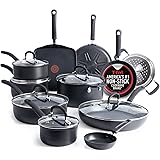
T-Fal Ultimate Hard Anodized Nonstick Pots and Pans Set 17 Piece, Nonstick Cookware Set with Fry Pan, Saucepans, Saute-Pan, Griddle, Dishwasher Safe, Onyx
$229.95 (as of October 23, 2026 19:19 GMT +00:00 - More infoProduct prices and availability are accurate as of the date/time indicated and are subject to change. Any price and availability information displayed on [relevant Amazon Site(s), as applicable] at the time of purchase will apply to the purchase of this product.)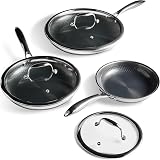
Now retrieving an image set.
HexClad 6pc Hybrid Nonstick Frying Pans Set with Lids, 8, 10 & 12" Pans | Stay-Cool Handles, Dishwasher and Oven Safe up to 900°F, Compatible with All Cooktops
$383.98 (as of October 23, 2026 19:19 GMT +00:00 - More infoProduct prices and availability are accurate as of the date/time indicated and are subject to change. Any price and availability information displayed on [relevant Amazon Site(s), as applicable] at the time of purchase will apply to the purchase of this product.)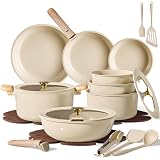
Now retrieving an image set.
CAROTE 25pcs Ceramic Cookware Set, Pots and Pans Set with Detachable Handle | Non-Stick, Non-Toxic, PFAS Free, Induction Compatible, Dishwasher & Oven Safe, Kitchen Organization, for Camping/RV/Gifts
$119.99 (as of October 23, 2026 19:19 GMT +00:00 - More infoProduct prices and availability are accurate as of the date/time indicated and are subject to change. Any price and availability information displayed on [relevant Amazon Site(s), as applicable] at the time of purchase will apply to the purchase of this product.)The location of the mass matters more than the number on a scale. Weight concentrated across the cooking surface can indicate a substantial base that spreads heat and stays flatter through repeated heating and cooling. Weight concentrated in a long steel handle, bulky knob, or thick glass lid says much less about the working part of the pan. A product can therefore feel impressively heavy in its packaging while still having a thin cooking surface.
Consider two same-size sauté pans. The first has a sturdy, moderately thick base and a hollow metal handle. The second has a thin body, a solid cast handle, and a heavy lid. The second package may weigh more, yet the first pan may sit flatter and provide steadier burner contact. Lifting each pan without its lid exposes the difference more clearly than comparing boxed weights.
Weight also offers different information for different vessel types. A cast-iron skillet is expected to be heavy because iron must be relatively thick to produce a rigid casting. A spun or formed aluminum pan may be much lighter while still offering useful thickness and responsive heating. A multiclad stainless vessel gains mass from multiple bonded layers, but its performance depends on how far those layers extend and how substantial the conductive core is.
The common mistake is treating heaviness as a universal grade. It is better viewed as an initial screening signal. Use it to ask where the material is, whether the vessel remains rigid, and whether the construction suits its purpose. If the base flexes, the empty pan tips toward its handle, or the rim twists easily, a high total weight should not override those weaknesses.
Compare Weight With Material and Construction
Meaningful weight comparisons require vessels of similar size, shape, and material. A 12-inch skillet should not be judged against a 10-inch skillet, and a bare cast-iron pan should not be ranked against a thin carbon-steel pan solely by heft. Different metals have different densities and are manufactured at different practical thicknesses, so equal quality does not mean equal weight.
Cast iron carries considerable mass and changes temperature slowly. Its heft can be useful for searing and oven cooking, where stability and heat storage are valuable. That same mass makes tossing food, washing the pan, and moving it while hot more demanding. Carbon steel is generally thinner and easier to maneuver. It may react faster to burner changes, but a very thin example can be more susceptible to unevenness or distortion under severe temperature changes.
Aluminum cookware can feel surprisingly light because aluminum is less dense than iron or steel. A well-made aluminum body may still be thick enough to distribute heat effectively. Hard-anodized surfaces change durability and finish characteristics, but the anodizing itself should not be mistaken for evidence of a thick body. Check the sidewall and base profile rather than dismissing a pan because it lacks cast-iron heft.
Stainless steel requires closer inspection because many stainless vessels use layered construction. Stainless provides a durable cooking surface but conducts heat less readily than aluminum or copper. Manufacturers commonly bond a more conductive metal into the base or throughout the body. A disc-base pot concentrates that layered mass beneath the cooking floor, while fully clad construction generally carries the bonded layers up the walls. Neither design should be judged from total weight alone: a disc base can be practical for boiling, while clad walls may be more useful for sauces and shallow cooking that involve heat along the sides.
| Construction | How to Read Its Weight | What to Check Next |
|---|---|---|
| Cast iron | High weight is normal for the material | Flatness, casting finish, handle control |
| Carbon steel | Moderate weight may reflect a thinner, responsive body | Base stability, thickness, handle attachment |
| Aluminum | Low weight does not automatically indicate low quality | Body thickness, rigidity, coating condition |
| Clad stainless steel | Mass may come from bonded layers | Layer coverage, base flatness, balance |
| Disc-base stainless steel | Useful mass should be concentrated under the floor | Disc coverage, attachment, edge transition |
Product specifications are most useful when they identify the body material, layer arrangement, and thickness rather than advertising weight as a feature. If two comparable pans have noticeably different weights, inspect their cross-sections, rims, and bases to determine why. The heavier option earns an advantage only when its extra material appears in parts that affect rigidity, heat movement, or durability.
How Do You Test Balance, Base, and Handle Control?
A hands-on balance test shows whether a pan’s weight will be useful during daily cooking. Place the empty vessel on a level surface and press gently near several points around the rim. It should remain steady rather than rocking. Rocking can result from the pan’s shape, manufacturing tolerances, or prior distortion, and it is particularly relevant on smooth electric and induction surfaces that depend on close base contact.
Next, lift the vessel by its main handle without the lid. The cooking body should feel controlled rather than dragging the wrist sharply downward or allowing the handle to roll in the hand. Then imagine the additional load from food and liquid. A four-quart pot becomes much harder to manage when nearly full, so an acceptable empty weight can become inconvenient at the sink or stove.
For a skillet, simulate normal movements instead of merely holding it at your side. Raise it a few inches, tilt it as if pouring sauce, and angle it as if sliding food onto a plate. A helper handle can substantially improve control on broad sauté pans and larger skillets. Check that both handles provide enough clearance for a secure grip and that their attachments do not show movement.
The base and rim deserve separate attention. Look across the underside at eye level for obvious bowing, then set the vessel down and test it again. Apply light hand pressure only; forcibly flexing store merchandise proves little and may damage it. At the top, a rigid rim can make a large stockpot easier to carry and less vulnerable to deformation. A rolled or reinforced rim may provide stiffness without adding excessive mass throughout the walls.
A practical store test can follow this short sequence:
- Remove the lid: Judge the working vessel separately from accessories.
- Check burner stability: Set it on a flat display surface and look for rocking.
- Lift from the main handle: Notice wrist strain and rotational control.
- Use every carrying point: Test helper handles with both hands.
- Inspect attachments: Look for loose fasteners, rough joints, or handle flex.
The usual failure is testing only the empty pan for a few seconds. Account for the dish you will cook: a skillet holding two eggs adds little load, while a Dutch oven filled with stew adds substantial weight. If possible, compare the listed empty weights at home by lifting an existing pot with a similar total load. Comfort is not cosmetic; a vessel that is difficult to control is more likely to remain unused or be handled awkwardly when hot.
Use This 5-Point Cookware Weight Check
A five-point check turns weight from a vague impression into a practical purchasing test. Begin with size equivalence. Compare the same diameter, approximate wall height, and lid configuration. Even a small increase in diameter adds material across the base and walls, making a larger pan naturally heavier without proving that it is more robust.
Second, identify the source of the mass. Read the construction description and inspect visible edges. On some clad cookware, an exposed rim may show the bonded layers. On a disc-base pot, the underside may reveal the footprint of the attached base. A thick glass lid can account for a surprising portion of a set’s listed shipping weight, so weigh or lift the body separately whenever possible.
Third, evaluate useful rigidity. The pan should sit securely, its rim should hold its shape under ordinary handling, and the handle connection should feel firm. Rigidity must still be interpreted by type: a thin carbon-steel pan will not feel like cast iron, but it should not seem flimsy relative to comparable carbon-steel models.
Fourth, assess control at realistic capacity. Estimate the foods and liquid normally added, then consider how that load changes the vessel. A heavy saucepan may feel luxurious while empty but become tiring when used to drain pasta. Conversely, a moderately heavy frying pan can remain manageable because it is usually carried with less food and may offer a helper handle.
Fifth, connect the weight to the heating task. For high-heat searing, a substantial base can reduce the temperature drop after food is added. For delicate sauces, faster response to burner adjustments may be more valuable than maximum heat storage. For boiling water, capacity, stable handles, and a secure lid can matter more than thick sidewalls.
Use the five checks in order: match the dimensions, locate the mass, verify rigidity, test loaded control, and match construction to the cooking job. A candidate that performs well across all five has a stronger case than one that merely wins on the scale.
Do not use price as a substitute for these observations. Expensive cookware can include refined finishes, complex handles, or brand-specific styling that add cost without changing the useful distribution of metal. Likewise, a lighter pan is not necessarily a compromise if it is flat, appropriately thick for its material, securely assembled, and comfortable for its intended task. Weight becomes decision-worthy only after those details explain it.
When Is Heavier Cookware the Wrong Choice?
Heavier cookware is the wrong choice when its handling burden exceeds the benefit of added heat capacity or rigidity. People with limited grip strength, wrist discomfort, restricted storage, or deep sinks may get more reliable use from a lighter vessel with two well-positioned handles. Choosing a pan that is safe and comfortable to move is more practical than buying the heaviest construction available.
Cooking style changes the calculation. Frequent stir-frying, tossing, pouring, and moving between burners favor manageable weight and responsive construction. Long braises and oven roasts place less emphasis on one-handed movement, so a heavy Dutch oven may be reasonable if it can be lifted safely with both handles. The oven and rack should also accommodate the loaded vessel without awkward positioning.
Stovetop compatibility creates another constraint. A broad, heavy pan that rocks or has poor contact may perform worse on a smooth cooktop than a lighter pan with a flat base. On induction, weight alone does not establish compatibility; the base must contain suitable magnetic material and make stable contact. On portable burners, oversized heavy vessels may exceed the appliance’s stated limits, so the manufacturer’s instructions take priority over assumptions based on sturdiness.
Storage and cleaning expose problems that a showroom lift may miss. Stacking several heavy pans can make lower pieces difficult to retrieve and may place stress on shelves. A large pan that barely fits the sink can be hard to wash without striking the basin or faucet. Dishwasher suitability, where claimed by the manufacturer, does not guarantee that loading a very heavy vessel will be convenient.
Signs that excess weight is working against you include avoiding the pan, needing two hands for tasks designed around one handle, losing control while pouring, or struggling to clean it. Signs of an appropriate choice include stable burner contact, predictable tilting, secure grips, and confidence moving the vessel at its normal cooking load. If two pans appear similarly sound, choose the lighter one when mobility and responsiveness dominate; choose the heavier one when heat storage, stationary cooking, and resistance to deformation matter more.
Frequently Asked Questions
Does heavier cookware always mean better quality?
No. Extra mass is valuable when it comes from a substantial cooking surface or useful reinforcement, but heavy lids and handles can increase weight without improving the pan body.
Should a good frying pan feel heavy?
It should feel stable and sufficiently rigid for its material, not necessarily heavy. A good frying pan must also remain controllable when tilted, lifted, and loaded with food.
How should two pans be compared by weight?
Compare pans with the same diameter, similar wall height, equivalent lids, and the same material or construction type. Remove the lids before judging the working bodies.
Is lightweight aluminum cookware low quality?
Not automatically. Aluminum is naturally light, so body thickness, flatness, rigidity, handle attachment, and surface condition provide better evidence than heft alone.
How can I estimate whether a pot will be too heavy when full?
Consider its empty weight plus the expected food and liquid load. Compare that combined load with a similar pot at home and test whether two-handed carrying and pouring feel controlled.
Conclusion
Cookware weight is most informative when it leads to better questions about construction. Compare equivalent sizes, remove the lid, identify which components create the mass, and inspect whether the base, walls, rim, and handles benefit from that material. A rigid, flat vessel with balanced handling is a stronger candidate than a heavier pan whose mass sits in decorative or poorly controlled components.
Match the final choice to actual use. Heat-storing weight can suit searing and stationary oven cooking, while lower mass may be preferable for tossing, pouring, washing, and frequent burner adjustments. Before buying, lift the pan from every handle, simulate serving movements, and account for its filled weight. The best result is not the highest number on a scale, but a vessel whose construction remains stable and whose load you can control confidently.