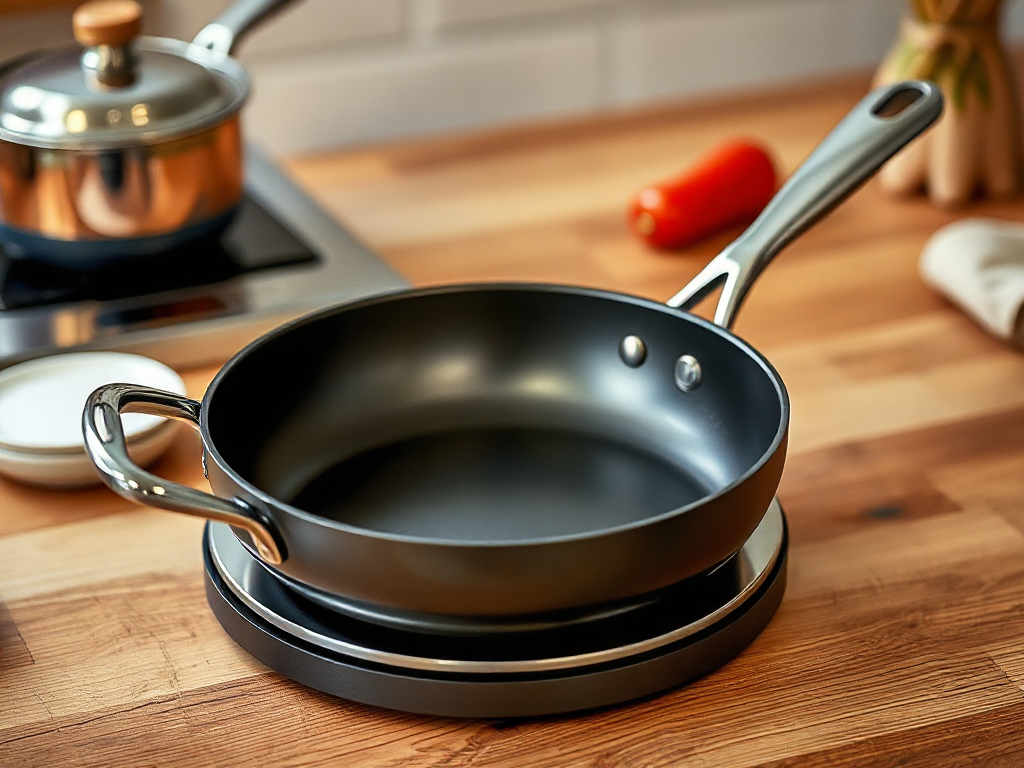
Evaluate cookware for induction compatibility by confirming an induction symbol or manufacturer specification, testing the base with a magnet, and checking that the pan has a flat, stable contact surface. Induction works through a magnetic field, so stainless steel, cast iron, and enameled iron may work, while aluminum, copper, glass, and ceramic usually need a magnetic bonded layer. A magnet that sticks firmly to the cooking base is a useful screening test, but it does not confirm ideal heating or size compatibility. Before buying, verify the exact model, inspect the base for warping, and match its diameter to the induction zone.
How Induction Compatibility Actually Works
Induction compatibility depends on whether the pan base can respond to the cooktop’s magnetic field. Unlike a gas flame or conventional electric element, an induction burner transfers energy through electromagnetic induction. The field interacts with a magnetic metal in the base, creating heat in the pan itself. The glass surface may become warm from contact with the pan, but it is not the primary heat source.
That mechanism explains why material labels alone can mislead. A pan described as “stainless steel” may be induction-ready if it contains a suitable magnetic layer, or it may fail if its base is made from nonmagnetic stainless steel. Cast iron generally responds well, and enameled cast iron usually does too. Plain aluminum, copper, glass, and ceramic cookware will not normally activate an induction zone unless the manufacturer has added a magnetic plate or bonded layer.
Some suggestions to consider!
Now retrieving an image set.
SENSARTE Ceramic Cookware Sets, Pots and Pans Set Non stick, 14 Piece Induction Cookware, Non toxic Healthy Non Stick Kitchen Cooking Set, with Frying Pans Set, PFAS PTFE PFOA PFOS Free
$79.99 (as of October 14, 2026 19:08 GMT +00:00 - More infoProduct prices and availability are accurate as of the date/time indicated and are subject to change. Any price and availability information displayed on [relevant Amazon Site(s), as applicable] at the time of purchase will apply to the purchase of this product.)
Now retrieving an image set.
Umite Chef 21Pcs Pots and Pans Set Non Stick, Nonstick Ceramic Cookware Sets Detachable Handle, Non Toxic Healthy Induction Cookware, Kitchen Cooking Set, with Frying Pans Set, Dishwasher/Oven Safe
$57.99 (as of October 14, 2026 19:08 GMT +00:00 - More infoProduct prices and availability are accurate as of the date/time indicated and are subject to change. Any price and availability information displayed on [relevant Amazon Site(s), as applicable] at the time of purchase will apply to the purchase of this product.)
Now retrieving an image set.
CAROTE 26pcs Pots and Pans Set Non Stick Cookware Sets | Induction Kitchen Cooking Set, Special Texture Design, Ultra Durable, Easy Food Release, Even Heating, with Frying Pans Set
$139.99 (as of October 14, 2026 19:08 GMT +00:00 - More infoProduct prices and availability are accurate as of the date/time indicated and are subject to change. Any price and availability information displayed on [relevant Amazon Site(s), as applicable] at the time of purchase will apply to the purchase of this product.)Compatibility is not the same as ideal performance. A small magnetic disk may allow a pan to work but produce uneven heating or a smaller effective hot area. A heavy cast-iron skillet can heat effectively but may be slow to respond when the power setting changes. A thin induction-ready stainless pan may react quickly but develop hot spots if its construction is poor. Readers comparing options through how to evaluate cookware for induction compatibility should therefore separate three questions: will the burner recognize it, will it heat evenly, and will it sit safely on the surface?
A frequent mistake is assuming that any metal pan is suitable. The relevant property is magnetic response at the base, not simply conductivity, weight, or a shiny appearance. Copper conducts heat well, but conductivity does not make it induction-compatible. Conversely, cast iron is magnetically responsive even though its heat response differs greatly from that of layered stainless steel.
Checks to Use Before Buying or Using a Pan
The most reliable first check is the product specification. Look for wording such as “suitable for induction,” “induction-ready,” or an induction-compatible symbol, commonly shown as a coil or series of loops. Check the exact pan model rather than relying on a brand’s general claim, because a manufacturer may sell several lines with different bases. Product pages, packaging, and care manuals can contain different levels of detail, so compare them when the listing is unclear.
A household magnet provides a practical screening test. Hold it against the exterior cooking base, not only the sidewall. A firm attraction suggests that the pan contains a magnetic material. If the magnet barely clings or slides off, the pan may not activate the burner reliably. Test several points across the base if possible. Attraction only at a small central disk may indicate limited magnetic coverage, while consistent pull across most of the base is a stronger sign of useful construction.
The magnet test has limits. It cannot tell you whether the pan will heat evenly, whether the base is too small for a particular zone, or whether the manufacturer permits induction use. It also may not reveal a design issue such as a warped bottom. Treat it as a preliminary check, then confirm the specifications. If you are testing a pan at home, place it on the correct induction zone with a small amount of water and use a moderate setting. Recognition, steady heating, and a stable pan position are more informative than running an empty pan at maximum power.
Use this compact buying sequence:
- Find an explicit induction statement for the exact model.
- Confirm magnetic attraction at multiple points on the base.
- Compare the stated base diameter with your cooktop’s zone sizes.
- Inspect the bottom for flatness, raised rings, deep grooves, or damage.
- Check the care instructions for induction-specific limitations and maximum heat guidance.
Do not treat a retailer filter as final proof. Filters can be wrong, especially when a product has several versions. A specification from the manufacturer is more useful than a generic marketplace label. This verification step is particularly worthwhile when buying vintage cookware, an imported pan, or a set whose pieces may use different base constructions.
Materials, Bases, and Common Misreadings
Cookware construction matters more than the name printed on the front of the box. Magnetic stainless steel can work directly with induction, while some stainless alloys are not magnetic. Many aluminum pans become compatible through a stainless or iron layer bonded into the base. That layer may be visible as a disk, concealed beneath another metal, or integrated into a multilayer body.
Cast iron offers a clear example of compatibility with tradeoffs. A cast-iron skillet usually activates an induction burner and retains heat for searing or frying. Its weight can make it awkward to move across a glass surface, and a rough underside may scratch if dragged. Enameled versions reduce contact concerns, but the pan still needs careful handling. A protective mat may be appropriate only if the cooktop and mat manufacturer permit it; an unsuitable layer can interfere with sensing or heat transfer.
Stainless cookware requires closer inspection. A fully clad pan may have magnetic stainless steel on the exterior and aluminum layers inside for heat distribution. A pan with a simple attached plate may activate the burner but behave differently around the edges. Neither design is automatically bad. The choice depends on whether you prioritize fast response, broad even heating, durability, or a lower purchase price.
Another weak assumption is that a heavier pan must be better for induction. Weight can reflect useful thickness, but it can also create handling problems without fixing uneven heating. Likewise, a pan that activates the cooktop is not necessarily safe to use at every setting. Excessive heat can discolor stainless steel, damage coatings, or cause a base to deform. Follow the pan’s care instructions and avoid judging quality from the magnet test alone.
When comparing a nonmagnetic favorite with an induction-ready replacement, an adapter plate may appear to solve the problem. It can allow some noncompatible pans to receive heat indirectly, but it adds another heated surface, slows response, and may reduce efficiency. It is more practical as an occasional solution than as a substitute for a well-matched pan used every day. The same distinction applies when researching induction-compatible cookware choices: technical activation is only the first filter.
Fit, Flatness, and Real-World Cooking Performance
A compatible pan still needs to match the induction zone. Cooktops sense cookware through an area beneath the glass, and a pan that is much smaller than the marked zone may be rejected or heat over a limited area. A large pan placed on a small zone may warm in the center while the edges remain relatively cool. Measure the manufacturer’s stated base diameter rather than the widest rim diameter, since the rim often overstates the area that actually contacts the burner.
Flatness affects both contact and stability. A slightly curved or warped base may cause delayed recognition, clicking sounds, uneven heating, or an unstable pan. Warping can result from thermal shock, such as placing a very hot pan under cold water, or from repeated overheating while empty. Set the pan on a flat counter and check whether it rocks. Inspect the base for a raised center, a detached disk, deep scratches, or buildup that prevents even contact.
Consider the cooking task when judging the result. A small saucepan with a concentrated magnetic base may be perfectly adequate for heating soup, but a wide skillet with limited magnetic coverage may brown food unevenly. For pancakes, eggs, or delicate sauces, even distribution matters more than maximum heat retention. For searing, a heavy base may be useful, provided the cooktop zone is appropriately sized and the handle remains manageable.
Induction response can also expose poor technique. High power heats compatible pans quickly, so oil may smoke before ingredients are ready and a coated pan may be stressed unnecessarily. Start at a moderate setting, watch how quickly the pan responds, and adjust rather than assuming the highest number is equivalent to a gas flame. If water heats steadily and the pan remains level, the setup is behaving as expected. If the burner cycles repeatedly, loses recognition, or produces a sharply localized hot spot, investigate pan size, base design, and surface condition.
Prioritize a documented magnetic base, broad and flat contact, suitable diameter, and construction that matches your recipes. A bargain pan that technically activates may be less useful than a slightly more expensive model with a stable multilayer base. For additional decision context, how to evaluate cookware for induction compatibility should include the cooktop manual, because individual burners can have minimum-size and placement requirements.
Frequently Asked Questions
Can a magnet prove that cookware is induction-compatible?
No. A strong magnetic response is a useful screening sign, but the product specification should confirm compatibility. The magnet cannot assess heating evenness, pan size, or cooktop restrictions.
Which cookware materials usually work on induction?
Cast iron, enameled iron, and magnetic stainless steel commonly work. Aluminum, copper, glass, and ceramic generally need a bonded magnetic base to activate an induction zone.
Why does an induction-ready pan heat unevenly?
Uneven heating may result from a small magnetic disk, poor base construction, a pan that is too large for the zone, or a warped bottom. Check the base diameter and flatness before replacing the pan.
Does the diameter of the rim matter?
The cooking base diameter matters more than the rim diameter. A wide rim can make a pan appear to match a zone even when the magnetic contact area is much smaller.
Can an adapter plate make any pan work on induction?
An adapter may transfer heat to some nonmagnetic pans, but it usually responds more slowly and may reduce efficiency. Use one only when its instructions are compatible with your cooktop and pan.
Conclusion
Assess induction cookware in layers rather than relying on a single symbol or magnet test. Confirm the exact model’s specification, test magnetic attraction across the base, measure the true contact diameter, and inspect the bottom for flatness and damage. Then judge the pan against the food you prepare: a saucepan for simmering has different demands from a wide skillet used for browning. Remember that activation does not guarantee even heating, and a heavier or more expensive pan is not automatically the better choice. If a pan behaves unpredictably, reduce the power, verify its placement and size, and consult the cooktop and cookware manuals before continuing. Those checks provide a more dependable basis for buying decisions than material names or retailer filters alone.