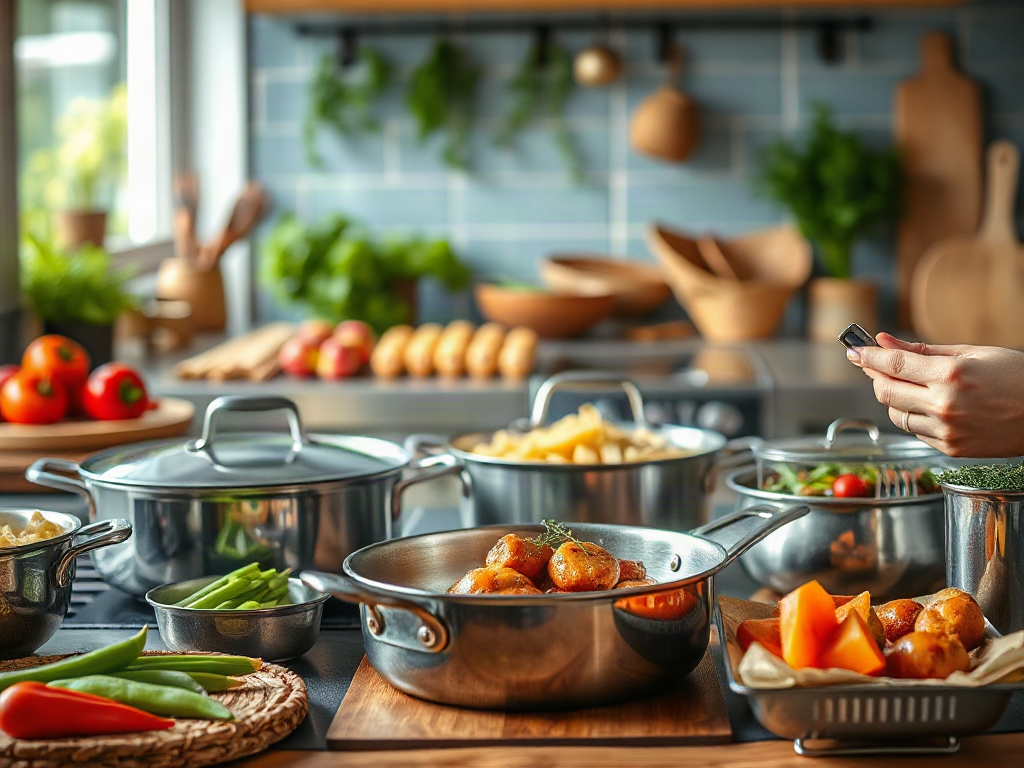
The role of cookware in meal prep efficiency is to reduce cooking time, interruptions, and cleanup by matching pan capacity, heat behavior, and task sequence to the foods being prepared. A wide skillet can brown vegetables without crowding, a heavy pot can hold a batch of grains or soup at a steady simmer, and nesting pieces can shorten washing and storage. Poorly matched cookware creates bottlenecks: small vessels require repeated batches, uneven heating causes extra monitoring, and delicate coatings may limit utensil or cleaning choices. The most efficient setup prioritizes the pans used most often, enough capacity for planned portions, compatible lids, and surfaces that can be cleaned without special handling.
Capacity and Shape Set the Pace
Cookware affects meal prep efficiency first through the amount of food it can handle in one pass. Capacity is not simply a matter of owning the largest vessel available; the useful size depends on whether ingredients need room to brown, simmer, steam, or be stirred. A broad sauté pan gives vegetables and diced chicken more contact with the hot surface, while a taller pot is better suited to pasta, beans, soup, or stock. Choosing the wrong shape can add extra batches even when the nominal volume appears adequate.
A crowded skillet illustrates the problem. Mushrooms or chopped vegetables release moisture as they cook. If they are piled too deeply, that moisture may collect faster than it evaporates, producing steaming rather than browning. The result is not merely a texture issue: the cook may need to work in multiple rounds, transfer food between containers, and wait for the pan to recover heat. A wider pan can shorten that chain when the recipe depends on surface contact.
Some suggestions to consider!
Now retrieving an image set.
SNOWCLAD Pots and Pans Set Non Stick | Stainless Steel Kitchen Cookware | 10 Pcs | PFOA Free | Hybrid | Induction Compatible | Frying Skillet, Saucepans, Saute Pan & Stock Pot
$169.99 (as of October 14, 2026 19:08 GMT +00:00 - More infoProduct prices and availability are accurate as of the date/time indicated and are subject to change. Any price and availability information displayed on [relevant Amazon Site(s), as applicable] at the time of purchase will apply to the purchase of this product.)
Now retrieving an image set.
CAROTE 21pcs Pots and Pans Set, Nonstick Cookware Sets | Titanium Reinforced Coating, Scratch-Resistant, Easy to Clean, Even Heating, Induction Compatible, with Frying Pans Set
$89.99 (as of October 14, 2026 19:08 GMT +00:00 - More infoProduct prices and availability are accurate as of the date/time indicated and are subject to change. Any price and availability information displayed on [relevant Amazon Site(s), as applicable] at the time of purchase will apply to the purchase of this product.)


CAROTE 21pcs Pots and Pans Set Non Stick, Detachable Handle Cookware Sets | Stackable Cooking Set, Dishwasher & Oven Safe, Induction Ready, for Kitchen/Apartment/Camping/RV, House Warming Gift
$59.99 (as of October 14, 2026 19:08 GMT +00:00 - More infoProduct prices and availability are accurate as of the date/time indicated and are subject to change. Any price and availability information displayed on [relevant Amazon Site(s), as applicable] at the time of purchase will apply to the purchase of this product.)Height matters just as much. A medium saucepan is convenient for grains and sauces, but it may be awkward for a large batch of chili because stirring becomes difficult and splashing increases. A stockpot handles volume, yet its broad base may not be ideal for reducing a small sauce. Efficient prep uses a vessel whose working area fits the food quantity rather than treating every task as a capacity contest.
Before buying another piece, compare the foods prepared most often with the cookware already available. Check whether vegetables fit in a single layer, whether a lid leaves enough headroom for simmering, and whether cooked portions can be lifted out without spilling. A useful internal link is the role of cookware in meal prep efficiency, particularly when planning a set around recurring weekly meals.
A common mistake is selecting a set because every piece looks coordinated while several pieces duplicate the same small size. For batch cooking, one dependable wide skillet, one lidded saucepan, and one appropriately sized pot may contribute more than a crowded collection. The tradeoff is storage space: larger vessels improve throughput only when they remain accessible and are not buried behind rarely used equipment.
Heat Behavior and Batch Quality
Material and construction influence how quickly cookware responds to heat and how evenly it distributes that heat across the cooking surface. Those properties affect meal prep because repeated batches are tiring when the first batch cooks differently from the second. A pan that develops hot spots may brown onions at the center while leaving the edges soft, forcing constant rearrangement and closer supervision.
Responsive cookware changes temperature relatively quickly when the burner is adjusted, which can be useful for sautéing, delicate sauces, and foods that move rapidly from searing to finishing. Heavier cookware generally stores more heat and may be useful for browning or maintaining a steady temperature when a substantial quantity of food is added. Neither behavior is automatically better. A heavy pan may take longer to preheat and be cumbersome to wash, while a light pan may cool noticeably when loaded with chilled ingredients.
Consider a meal-prep sequence involving chicken, peppers, and rice. A stable skillet can sear the chicken without losing as much heat when several pieces enter at once. After the chicken is removed, the same pan can soften peppers and collect browned flavor from the surface. Rice can cook separately in a lidded saucepan, leaving the skillet available for the next task. If the skillet is too thin or too small, the cook may need to lower the heat, divide the chicken, or accept uneven browning.
Surface material also changes the workflow. Nonstick cookware can simplify eggs, fish, and low-fat cooking, but its care instructions may limit high-heat use or abrasive cleaning. Stainless steel can tolerate many cooking tasks and develops fond useful for sauces, although sticking is more likely when the pan is poorly preheated or the food is moved too early. Cast iron holds heat well, but its weight and maintenance may make it less convenient for rapid washing and repeated handling.
Judge performance by the signs visible during preparation. A pan is working well when food cooks at a predictable rate, the burner does not require constant correction, and the cooking surface is large enough to avoid crowding. Persistent scorching in one area, weak browning despite a suitable recipe, or long recovery after adding ingredients signals a mismatch. Do not assume a higher price alone solves those problems; size, burner compatibility, and cooking habits remain decisive.
A Cookware Sequence for Faster Prep
Efficient meal prep comes from arranging cookware around the order of operations, not from using every piece at once. A useful sequence separates tasks that need active attention from those that can cook with a lid. For example, rice or lentils can begin in a saucepan while vegetables are washed and cut. A skillet can then handle aromatics and a protein, while a large pot remains available for blanching, pasta, or a combined dish.
Cookware with compatible lids creates another advantage: it allows food to rest, steam, or finish gently without occupying the cook’s hands. A covered pot can hold cooked grains briefly, and a lidded sauté pan can finish vegetables with a small amount of liquid. This does not mean every step should be covered. Trapped steam can soften foods that need crisp edges, and an uncovered pan may be preferable when reducing a sauce or evaporating moisture from vegetables.
The most efficient sequence depends on the menu. A three-part meal may require separate cookware if flavors, textures, or cooking times differ sharply. A one-pot stew benefits from a vessel that can brown ingredients and then simmer them without transferring contents. A sheet-pan-style preparation, by contrast, may reduce stovetop demand but does not replace a saucepan for grains or a skillet for a quick sauce.
Try assigning each piece a job before turning on the burner:
- Primary skillet: browning, sautéing, or reheating foods that need surface contact.
- Lidded saucepan: grains, sauces, eggs, and smaller portions.
- Large pot or Dutch oven: soups, pasta, braises, and high-volume batches.
- Colander or insert: draining or steaming without transferring food through several containers.
A frequent failure mode is starting with the most convenient pan instead of the pan that controls the schedule. A small saucepan may be close at hand, but using it for a large sauce creates splashes, slow reduction, and repeated stirring. Conversely, using a very large pot for a small portion can make evaporation and temperature control less predictable. Efficient prep is usually a balance between fewer transfers and appropriate working space.
For a deeper planning reference, the role of cookware in meal prep efficiency can be treated as a scheduling question: which vessel can cook unattended, which requires attention, and which becomes available next? That simple map often reveals that the limiting factor is not burner power but a missing lid, narrow pan, or poorly timed handoff.
Cleanup, Storage, and Long-Term Efficiency
Meal prep efficiency does not end when the food leaves the burner. Cookware that is difficult to clean, dry, or store can erase the time saved during cooking. A pan with baked-on residue may require soaking and repeated scrubbing, while a vessel with a practical lid can move from stovetop to refrigerator only when its material and manufacturer instructions permit that use. Storage decisions should be based on actual care requirements rather than convenience alone.
One-pot cooking can reduce the number of dishes, but it is not automatically faster. A large pot containing starch, sauce, and protein may be efficient for a stew, yet difficult to wash if food dries around the rim or settles into corners. Separating components in two easier-to-clean vessels may produce a better total workflow, especially when the meal will be portioned into several containers. The right comparison includes washing, drying, cooling, and storage.
Surface care also affects future prep. Scratched or degraded nonstick surfaces may make food release less predictable and can lead to more oil, lower heat, or extra scraping. Stainless steel may need prompt soaking after a sticky reduction, but it is often versatile across browning, deglazing, and simmering tasks. Cast iron can be durable, although it should be dried thoroughly and maintained according to the maker’s care guidance to limit rust and preserve its cooking surface.
Handle design and weight deserve attention during a large batch. A full pot is harder to lift than an empty one, and a long handle may collide with nearby burners or storage shelves. Two side handles can make a heavy vessel easier to move, but they may reduce usable stovetop space. These practical details matter more during weekly prep than they do during an occasional single serving.
Use a short post-cooking check to identify hidden inefficiency:
- Did food stick because of technique, temperature, or a surface mismatch?
- Did the vessel cool too much when loaded, requiring a longer cook?
- Did its shape make stirring, draining, or portioning awkward?
- Can it be cleaned with the tools and time available in the household?
Replacing cookware should follow repeated evidence, not a single frustrating meal. If the same pan causes crowding or difficult cleanup every week, it is a meaningful bottleneck. If the issue occurred once because ingredients were unusually cold or the pan was overfilled, changing technique may be more sensible than buying new equipment.
A Practical Cookware Priority List
The strongest cookware setup is the one that supports the meals actually prepared. Start by listing recurring tasks such as sautéing vegetables, cooking grains, reheating leftovers, making soup, or preparing protein. Record which step takes longest and which vessel forces repetition. That information is more useful than a generic recommendation to own a complete set.
Prioritize capacity before specialty features. A wide, lidded skillet may serve more weekly meals than a small specialty pan because it can brown, simmer, reheat, and finish several portions. Next, consider heat behavior and compatibility with the cooktop. A piece that heats unevenly or sits poorly on the burner can undermine the advantages of its material. Ease of handling comes before decorative finish when the vessel will be full and hot.
A sensible decision framework is:
- Identify the recurring bottleneck. Count repeated batches, long waits, difficult transfers, and cleanup problems.
- Match vessel geometry to the food. Choose width for browning, depth for liquids, and a lid when covered cooking is part of the routine.
- Check the complete workflow. Include utensils, draining, cooling, refrigeration, washing, and storage.
- Test technique before replacing equipment. Reduce crowding, preheat appropriately, or divide ingredients when those changes address the cause.
For instance, someone preparing roasted vegetables, rice, and a protein may benefit more from a broad skillet and reliable saucepan than from several small pans. Someone making soups and braises may value a large, stable pot and easy-clean tools instead. A household with limited storage should favor nesting shapes and frequently used sizes, while a large family may prioritize extra capacity even if the pieces require more shelf space.
The weak assumption is that more cookware automatically means faster prep. Excess pieces can create clutter, slow selection, and leave the most useful pan buried. Efficiency comes from reducing interruptions while preserving control over heat, portion size, texture, and cleanup. A final link to the role of cookware in meal prep efficiency is most useful when reviewing whether each purchase removes a documented obstacle rather than adding another rarely used option.
For care limits, oven compatibility, and safe handling, consult the manufacturer’s documentation for each vessel. University extension cooking resources and recognized consumer-safety organizations can also provide practical guidance on food handling, cooling, and cleaning without replacing product-specific instructions.
Frequently Asked Questions
Which cookware size is most useful for weekly meal prep?
A wide skillet and a medium lidded saucepan are useful starting points for many households. Add a larger pot when soups, pasta, grains, or batch portions regularly exceed those vessels.
Does heavier cookware always make meal prep faster?
No. Heavier cookware may hold heat well for browning, but it can preheat slowly, weigh more when full, and take longer to wash. Choose based on the food and the complete workflow.
Why does a small pan slow down batch cooking?
A small surface crowds ingredients, allowing moisture to build up and reducing browning. It also forces repeated batches, transfers, and reheating periods.
Is nonstick cookware efficient for meal preparation?
It can be efficient for foods that release poorly, such as eggs or delicate fish, because cleanup is often simpler. Follow the maker’s heat, utensil, and cleaning instructions.
How can cookware reduce cleanup without sacrificing meal quality?
Use a vessel that fits the batch, choose one-pot methods when the foods share a suitable cooking environment, and avoid overfilling. A second pan may be better when separate textures or easier washing matter.
Conclusion
Cookware improves meal prep efficiency when its size, shape, heat behavior, and care requirements match the foods prepared most often. Start with the bottleneck: repeated skillet batches, a saucepan that lacks capacity, uneven heating, awkward transfers, or cleanup that consumes the evening. Then choose the smallest change that removes that obstacle. A broad skillet can support browning, a lidded saucepan can free attention while grains cook, and a properly sized pot can turn several rounds into one controlled batch. Technique still matters; avoiding crowding and sequencing tasks well may solve a problem without another purchase. Review the setup after several prep sessions and keep only pieces that make cooking, portioning, or cleaning measurably easier.