Select cookware for specific diets by matching the pan’s surface, heat response, and cleanability to the foods and cooking methods used most often. Nonreactive stainless steel suits acidic sauces and varied everyday meals, while seasoned cast iron supports high-heat searing but requires maintenance. A dependable nonstick skillet can reduce added cooking fat for eggs and delicate foods, although it should not be overheated. For households managing food allergies, celiac disease, or strict religious separation, prioritize smooth, easily inspected pieces and consider dedicated pans when ordinary washing cannot reliably control cross-contact.
Translate Diet Needs Into Cookware Requirements
A diet label does not identify a single ideal pan. The useful starting point is the actual menu: ingredients, cooking temperatures, batch sizes, added-fat preferences, and any need to keep foods separate. Two people following a plant-based diet may need different equipment if one prepares quick tofu stir-fries while the other cooks large batches of beans, tomato sauce, and whole grains.
Some suggestions to consider!
Now retrieving an image set.
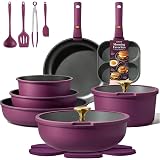
CAROTE 21pcs Pots and Pans Set Non Stick, Detachable Handle Cookware Sets | Ultra Nonstick, Space Saving, Dishwasher & Oven Safe, Non-Toxic Kitchen/Apartment/Camping/RV/ Traveling, Purple
$99.96 (as of October 21, 2026 19:18 GMT +00:00 - More infoProduct prices and availability are accurate as of the date/time indicated and are subject to change. Any price and availability information displayed on [relevant Amazon Site(s), as applicable] at the time of purchase will apply to the purchase of this product.)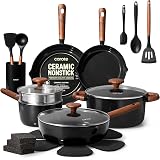
Now retrieving an image set.
CAROTE 22pcs Ceramic Cookware Set, Pots and Pans Set | Non-Toxic Healthy Cooking Set with Glass Lids, Even Heating, with Steamer & Utensils Set & Sponge Eraser, PFAS FREE
$79.97 (as of October 21, 2026 19:18 GMT +00:00 - More infoProduct prices and availability are accurate as of the date/time indicated and are subject to change. Any price and availability information displayed on [relevant Amazon Site(s), as applicable] at the time of purchase will apply to the purchase of this product.)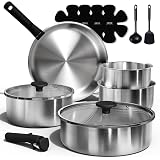
Now retrieving an image set.
CAROTE 15pcs Tri-Ply Stainless Steel Cookware Set with Detachable Handle | Pots and Pans Set, Non-Toxic, Induction Compatible, Dishwasher& Oven Safe, Easy Storage, for Kitchen/Camping/RV Cooking
$59.99 (as of October 21, 2026 19:18 GMT +00:00 - More infoProduct prices and availability are accurate as of the date/time indicated and are subject to change. Any price and availability information displayed on [relevant Amazon Site(s), as applicable] at the time of purchase will apply to the purchase of this product.)Write down the five or six dishes made most frequently and note what each dish asks of a vessel. Tomato-based lentil stew needs enough capacity and a nonreactive interior. Eggs cooked with little oil benefit from a low-stick surface and controlled heat. Seared fish or mushrooms need a broad pan that can hold heat without becoming crowded. Long-simmered beans need a stable pot with a well-fitting lid rather than an expensive frying pan.
The distinction between a dietary goal and a cooking requirement prevents weak purchases. A pan marketed for “healthy cooking” may still be unsuitable if its usable cooking area is too small, its handle is uncomfortable when full, or its coating cannot tolerate the temperatures used at home. Likewise, buying an entire matching set often creates duplicates while omitting the one deep sauté pan or stockpot the menu requires.
Use this compact priority check before comparing brands:
- List core foods: Include acidic ingredients, sticky proteins, grains, legumes, vegetables, and sauces.
- Match the method: Separate simmering, steaming, sautéing, baking, and high-heat browning.
- Identify separation needs: Decide whether normal washing is sufficient or dedicated equipment is warranted.
- Set maintenance limits: Be realistic about seasoning, hand-washing, polishing, and careful storage.
- Buy by task: Prioritize heavily used pieces before expanding into a set.
A selection is working when food releases predictably, batch sizes fit without crowding, and cleanup is manageable enough that the pan is used regularly. Warning signs include avoiding a heavy pot, repeatedly scorching grains in a thin base, damaging a coating with high heat, or using one difficult-to-clean piece for foods that must remain separate. Those failures usually point to a mismatch between the vessel and the routine, not a need for more cookware.
Which Material Fits the Foods You Cook?
Material matters because it influences reactivity, heat distribution, heat retention, food release, weight, and maintenance. No material leads every category, so the sensible choice follows the dominant foods and methods rather than a universal ranking.
Stainless steel is a versatile choice for tomato sauce, citrus-based dishes, soups, curries, and mixed menus because its cooking surface is nonreactive. Fully clad construction or a substantial bonded base spreads heat more evenly than very thin steel. Stainless steel can brown vegetables, meat substitutes, fish, and poultry well, but it is not naturally low-stick. Preheating moderately, adding an appropriate amount of cooking fat, and allowing food to release after browning make a larger difference than aggressive scraping.
Nonstick cookware is useful for eggs, pancakes, delicate fish, and recipes prepared with modest added fat. Its limitations are temperature and durability. It is a poor default for hard searing, broiler use unless the manufacturer permits it, or routines involving metal utensils. A worn, peeling, or deeply scratched cooking surface should not be treated as normal. Buyers should check the maker’s heat, utensil, oven, and cleaning instructions rather than assuming all coatings behave alike.
Cast iron and carbon steel retain heat well and can develop a low-stick seasoned surface. They suit browning, roasting, flatbreads, and many one-pan meals. Their tradeoffs include weight, seasoning upkeep, and variable performance with prolonged acidic cooking, which may affect the seasoning and the food’s flavor. An enameled cast-iron pot avoids the bare reactive surface and works well for braises and acidic stews, although it remains heavy and can be costly.
| Cooking priority | Practical option | Main limitation |
|---|---|---|
| Acidic sauces and varied meals | Clad or heavy-base stainless steel | Requires heat and fat control for sticking |
| Eggs and delicate foods with less oil | Nonstick skillet | Coating has heat and utensil restrictions |
| High-heat browning | Cast iron or carbon steel | Heavy or maintenance-intensive |
| Long stews and braises | Stainless steel or enameled cast iron | Premium versions may be expensive |
Whole-food plant-based kitchens often benefit more from a wide stainless sauté pan and a heavy pot than from several small skillets: vegetables need surface area, while beans and grains need controlled simmering. A low-fat breakfast routine may justify one small nonstick skillet instead. The common mistake is choosing a material for its reputation while ignoring the foods that will actually touch it.
How Should Allergies and Food Separation Change Your Choice?
Food-allergy, celiac, and strict separation requirements shift attention from heat performance to cross-contact control. Cookware alone cannot make a kitchen safe; ingredients, utensils, cutting boards, storage, hands, and shared appliances also affect exposure. Individual medical needs differ, so a clinician or registered dietitian familiar with the person’s condition should guide health-related restrictions.
Smooth, intact surfaces are easier to wash and inspect than damaged, porous, or heavily creviced equipment. Stainless steel pots and pans are often practical because their interiors tolerate thorough cleaning and do not depend on a fragile coating. Glass bakeware can also be easy to identify and inspect. Removable gaskets, rivets, rolled rims, textured interiors, and deep scratches deserve attention because residue can be harder to see or reach there.
Dedicated cookware may be reasonable when the consequence of cross-contact is serious, when a shared item cannot be cleaned confidently, or when household routines make mix-ups likely. A separate toaster or colander may matter more than a separate stainless skillet because crumbs lodge inside a toaster and pasta water passes through numerous small holes. Similarly, a scratched nonstick pan used for both allergen-containing and allergen-free meals may be harder to inspect than a smooth dedicated saucepan.
Religious dietary practices can impose different separation rules from medical diets. The appropriate setup depends on the household’s observance and trusted religious guidance; cookware articles should not substitute for that authority. Color-coded handles, clearly marked storage, and distinct shapes can reduce accidental switching. Labels need to survive washing and remain visible from the storage position.
A realistic test is to follow a meal from storage to serving. Note every surface touched by the ingredient, including lids, spoons, strainers, sheet pans, and cooling racks. If the process repeatedly relies on remembering which identical pan is reserved, change the visual system rather than expecting perfect recall. Separation is failing when labels disappear, cookware is stacked interchangeably while soiled, or family members cannot explain the routine. In that situation, fewer dedicated pieces with obvious identification are usually more reliable than a large, complicated collection.
Build a Small Diet-Specific Cookware Kit
A focused kit should cover the recurring menu with the fewest functional gaps. Start with pan shape and capacity, then choose material. Diameter alone can mislead: sloped sides reduce the flat cooking area, while a saucepan filled to its advertised capacity may leave too little room for stirring or boiling safely.
For a household cooking vegetables, legumes, whole grains, and acidic sauces, a useful foundation is a medium stainless saucepan, a larger heavy-base pot, a broad sauté pan, and a rimmed sheet pan. Add a steamer insert if steaming is frequent. Someone following a lower-fat pattern might add one nonstick skillet for eggs or fragile foods, but that surface does not need to replace every pan. Oil quantity is also shaped by technique, recipe, heat, and food moisture; a specific material does not guarantee a particular dietary result.
A high-protein menu built around fish, poultry, tofu, or seitan may place more value on browning space. A 10- or 12-inch skillet can be more useful than a compact saucepan, provided the burner heats it evenly and the user can lift it safely. Cast iron offers strong heat retention, while clad stainless responds more quickly when the burner setting changes. Neither choice is automatically better: heat retention favors searing and oven finishing, while responsiveness helps with sauces and temperature-sensitive cooking.
Budget decisions should favor the pieces where construction changes performance. A flat, stable base and comfortable fixed handle are worth prioritizing in a frequently used skillet. A basic stockpot may be sufficient for boiling or broth if its base remains stable and its handles are secure. Test handle comfort with the pot weighted if possible, confirm compatibility with the cooktop, and check the manufacturer’s oven and dishwasher limits.
Avoid purchasing a large set merely because the unit price appears lower. Count the pieces that match the written menu, excluding lids from the comparison. After several weeks, review which pans are used, where food routinely sticks or scorches, and whether capacity is adequate. Add one piece only when a repeated task remains poorly served. That staged approach leaves room for dietary habits to change and prevents storage from filling with cookware that looked suitable but does not fit the household’s methods.
Conclusion
Let the weekly menu determine the purchase rather than a broad dietary label or material ranking. Identify the foods that are acidic, delicate, sticky, or cooked at high heat; then match those tasks to surface behavior, capacity, weight, and cleaning needs. Stainless steel covers the widest range, while nonstick, cast iron, carbon steel, or enameled cookware can fill specific gaps.
Households managing cross-contact should examine the entire preparation path and reserve equipment where cleaning or identification is unreliable. Everyone else can usually begin with a small task-based kit, follow the maker’s care limits, and expand only after a recurring problem appears. Before buying, verify usable cooking area, cooktop compatibility, handle comfort, oven limits, and whether the maintenance routine is realistic. A few well-matched pieces will usually serve a specialized menu better than a large coordinated set.
Frequently Asked Questions
Is stainless steel suitable for most special diets?
Stainless steel suits many menus because it handles acidic foods, browning, and thorough cleaning. It may require more technique and some cooking fat for foods prone to sticking.
Does nonstick cookware make a diet healthier?
No pan determines a diet’s healthfulness. Nonstick may make certain foods easier to prepare with less added fat, but ingredients, portions, overall eating patterns, and cooking temperature still matter.
Should gluten-free households use dedicated pans?
The answer depends on cross-contact risk and the item’s cleanability. Smooth pans may be washable, while crumb-catching or hard-to-clean equipment may warrant dedicated use based on professional guidance.
What cookware is practical for plant-based meals?
A broad sauté pan, sturdy saucepan, larger pot, and sheet pan cover common tasks such as browning tofu, cooking grains, simmering beans, preparing tomato sauces, and roasting vegetables.
Is a cookware set better than buying individual pieces?
Individual pieces are usually more efficient when a diet relies on a few repeated methods. A set makes sense only when most included sizes match the household’s menu, cooktop, storage, and maintenance habits.