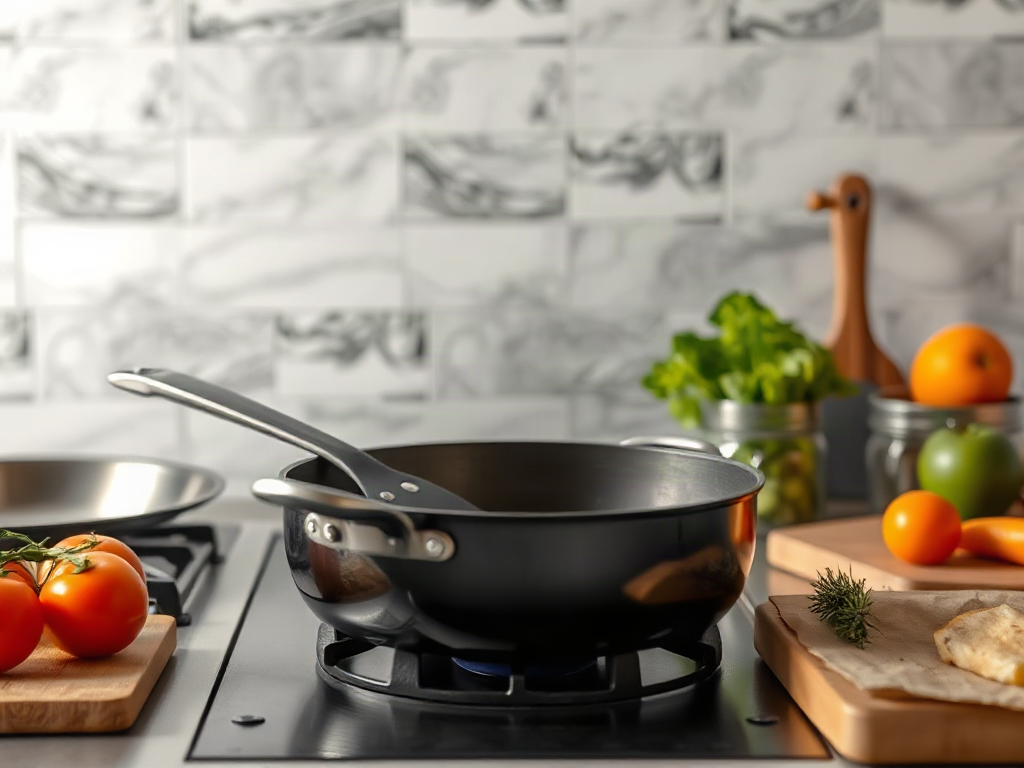
Choose cookware based on heat source by matching the pan’s base, material, and temperature tolerance to the way the cooktop transfers energy. Induction requires a flat magnetic base, radiant electric performs best with smooth, level cookware, and gas benefits from materials that spread concentrated flame heat evenly. Also check burner size, pan weight, handle exposure, oven limits, and the manufacturer’s compatibility markings before buying. A pan may technically work on a stove yet still heat slowly, wobble, develop hot spots, or waste energy when its construction does not suit that heat source.
How Does Each Heat Source Affect a Pan?
A cooktop’s method of transferring energy determines where a pan becomes hot, how quickly its temperature changes, and how much of its surface participates in cooking. Gas flames heat the bottom and may curl around the sides. Electric coils and radiant glass elements transfer heat through direct contact and retained surface heat. Induction creates heat within a compatible pan through an electromagnetic field rather than first heating a burner.
Some suggestions to consider!
Now retrieving an image set.
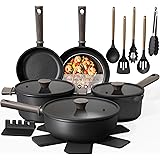
Astercook 19 Pcs Pots and Pans Set Non Stick, Black Titanium Induction Kitchen Cookware Sets, Non toxic Healthy Kitchen Cooking Set with Frying Pans Set, PTFE PFOA PFOS Free, Fathers Day Gift for Men
$79.99 (as of October 14, 2026 19:08 GMT +00:00 - More infoProduct prices and availability are accurate as of the date/time indicated and are subject to change. Any price and availability information displayed on [relevant Amazon Site(s), as applicable] at the time of purchase will apply to the purchase of this product.)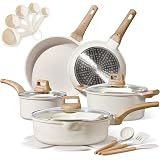
Now retrieving an image set.
CAROTE 20pcs Pots and Pans Set, Nonstick Cookware Sets | Induction Cooking, Ultra Durable, Easy to Clean, Even Heating, All-Stovetop Compatible, PFOA-Free Kitchen Set
$69.99 (as of October 14, 2026 19:08 GMT +00:00 - More infoProduct prices and availability are accurate as of the date/time indicated and are subject to change. Any price and availability information displayed on [relevant Amazon Site(s), as applicable] at the time of purchase will apply to the purchase of this product.)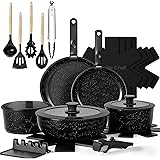
Now retrieving an image set.
Umite Chef 21Pcs Pots and Pans Set Non Stick, Nonstick Ceramic Cookware Sets Detachable Handle, Non Toxic Healthy Induction Cookware, Kitchen Cooking Set, with Frying Pans Set, Dishwasher/Oven Safe
$57.99 (as of October 14, 2026 19:08 GMT +00:00 - More infoProduct prices and availability are accurate as of the date/time indicated and are subject to change. Any price and availability information displayed on [relevant Amazon Site(s), as applicable] at the time of purchase will apply to the purchase of this product.)Those differences make base construction more consequential than a material name printed on the box. Thin stainless steel may react quickly over a flame but develop a hot ring directly above the burner. Thick cast iron spreads heat more slowly and retains it after the setting changes. Aluminum conducts heat well, but bare aluminum is not magnetic and therefore cannot operate on induction unless the pan includes a bonded magnetic layer.
Pan diameter matters as well. A small gas flame under a wide sauté pan concentrates energy in the center, leaving the perimeter cooler. A pan that extends far beyond an electric element heats unevenly because the unsupported outer area receives little direct energy. On induction, the cooking zone must detect enough magnetic material in the base; a very small pot may not activate a large zone even when the material itself is compatible.
Thermal response should match the food and the cook’s habits. Responsive clad stainless steel is useful when a sauce needs quick temperature corrections. Heavy enameled cast iron suits braises because it changes temperature gradually and holds steady heat, although it can overshoot if preheated aggressively. Copper offers excellent response but ordinarily needs a stainless lining and an induction-compatible base if it will be used on induction.
A common mistake is treating compatibility as proof of good performance. A pan labeled for all cooktops may contain only a thin magnetic plate, have a base smaller than its stated diameter, or warp enough to lose effective contact with a glass surface. Compatibility means the pan can function; construction quality, flatness, and burner matching determine how well it cooks.
Which Cookware Works on Gas and Electric Stoves?
Gas accepts almost every conventional cookware material, but it places concentrated heat and open flame beneath the vessel. Fully clad stainless steel is a versatile choice because its conductive core extends beyond the center and reduces sharp hot spots. Cast iron and carbon steel also work well, especially for searing, though both respond more slowly than thinner clad pans. Aluminum performs efficiently but may discolor on the exterior and should not be left empty over a strong flame.
Flame size should remain beneath the base rather than climbing the sidewalls. Flames that extend past the bottom waste fuel, heat handles, scorch exterior finishes, and can damage silicone grips. This is particularly relevant to small saucepans placed over high-output burners. Matching the burner to the actual base diameter provides better control than simply selecting the largest burner available.
Electric coil stoves work most predictably with pans that have level, reasonably thick bottoms. A warped skillet touches a coil at only a few points, producing unstable heating and possible wobbling. Cast iron is compatible, but sliding a heavy rough-bottomed pan can damage some surfaces or elements. Lift it when repositioning and avoid dropping it.
Radiant glass and ceramic cooktops make flatness even more important because heat crosses the contact area between the smooth cooktop and pan. Stainless steel with an aluminum core is usually a practical match. Heavy-bottomed aluminum may also perform well when the manufacturer approves it for that surface. Glass cookware can be slow to respond, while stoneware and earthenware should not be assumed to tolerate direct stovetop heat unless specifically designed for it.
Electric elements remain hot after being turned down or off. Cooks moving from gas often scorch butter or sauces because they expect an immediate temperature drop. Moving the pan to a cool zone gives faster control than waiting for the element to cool. Conversely, a thick pan can smooth the element’s cycling, making it useful for steady simmering at the cost of slower corrections.
Inspect the underside before using older cookware on a smooth-top stove. Raised logos, rough casting, burned residue, or a bowed base can reduce contact and mark the surface. The assumption that any pan used successfully on gas will perform equally well on glass-top electric is unreliable; gas surrounds irregularities with hot combustion gases, while radiant electric depends much more heavily on close, stable contact.
What Makes Cookware Suitable for Induction?
Induction cookware needs a magnetic base that is sufficiently flat and appropriately sized for the cooking zone. Cast iron and many carbon-steel pans are naturally magnetic. Some stainless-steel alloys work, while others do not, so the words “stainless steel” alone do not confirm compatibility. Aluminum, copper, glass, and ceramic require an integrated magnetic base to operate on induction.
A simple magnet test offers a useful initial check. Place a refrigerator magnet against the underside of the pan; a firm attraction indicates that the base is likely induction-capable. A weak attraction may correspond with poor detection or reduced performance, depending on the cooktop. The definitive checks are the induction symbol or statement on the cookware and the appliance manufacturer’s requirements.
| Cookware construction | Typical induction status | What to verify |
|---|---|---|
| Cast iron | Usually compatible | Flatness, weight, and surface condition |
| Carbon steel | Usually compatible | Base stability and minimum pan diameter |
| Stainless steel | Varies by alloy and construction | Magnetic base or induction marking |
| Aluminum or copper | Not compatible by itself | Bonded magnetic induction plate |
| Glass or ceramic | Generally incompatible | Manufacturer-approved magnetic base |
Base design affects more than detection. A thin attached disc may heat primarily within its own diameter, which can leave the edges of a broad skillet cooler. Fully clad induction-ready cookware can distribute energy farther up the walls, although construction varies and a higher price does not automatically guarantee a perfectly even cooking surface.
Noise is another practical consideration. Light pans, loose layers, or slightly uneven bases may hum or buzz as the electromagnetic field pulses. Some sound can also come from the appliance’s cooling fan. Persistent vibration, erratic detection, or repeated power cycling may indicate that the pan is too small, poorly centered, warped, or only weakly magnetic.
Induction can heat a compatible empty pan very quickly. High power is rarely the best starting point for nonstick coatings, seasoned carbon steel, or enameled cookware. Begin at a moderate setting, add cooking fat or food at the appropriate time, and increase power only as needed. The common failure mode is applying maximum power because the cooking surface appears cool; the pan itself may already be reaching a damaging temperature.
A Practical Cookware Selection Checklist
Selection should begin with the cooktop you use most, followed by the foods you prepare and the physical limits of your kitchen. A household with induction today but a possible gas range later benefits from magnetic fully clad stainless steel or induction-ready cast iron. Someone using a radiant glass rental stove may place greater value on a smooth, flat, manageable base than on extreme heat retention.
Use the following order when evaluating an individual pot or pan:
- Confirm compatibility. Read the cooktop markings, test for magnetism when relevant, and check both cookware and appliance instructions.
- Measure the working base. Compare the flat contact area—not the flared rim—with the burner or induction-zone diameter.
- Check flatness and stability. Set the empty pan on a level counter. Rocking or visible gaps can impair electric and induction performance.
- Match heat behavior to the food. Favor responsive clad cookware for sauces and sautéing; choose heavier vessels for frying, braising, and steady simmering.
- Review operating limits. Check oven temperature ratings, broiler approval, lid limits, handle materials, and restrictions on empty preheating.
Weight deserves a hands-on assessment. A large cast-iron Dutch oven may suit an induction zone perfectly yet become difficult to lift once filled. Heavy cookware can also be awkward on a delicate glass surface. Test whether you can move the vessel with control, including while wearing oven mitts, rather than judging weight only when it is empty on a store shelf.
Sets often encourage poor compromises. One material does not need to fill every role. A practical mixed collection might include a clad stainless saucepan for responsive heating, an induction-compatible nonstick skillet for lower-temperature foods, and a cast-iron or carbon-steel pan for searing. Buying by cooking task also avoids paying for oversized stockpots or tiny pans that do not align with available burners.
Signs of a good match appear during normal use: the pan sits securely, heats across the useful cooking area, responds predictably to control changes, and does not force the burner to run at maximum power for routine tasks. Warning signs include repeated center scorching, cold edges, delayed induction detection, wobbling, strong vibration, hot handles, or flames reaching beyond the base. Before replacing the pan, verify burner size, centering, and power level; if those are correct, the construction is probably a poor match for the heat source.
Frequently Asked Questions
Can the same cookware be used on gas, electric, and induction?
Yes, if it has a flat magnetic base and the manufacturer approves it for all three. Its performance may still differ because gas, radiant electric, and induction distribute heat in different ways.
How can I tell whether a pan will work on induction?
Look for an induction symbol or compatibility statement and test the bottom with a magnet. Strong attraction is a useful indicator, but appliance requirements and minimum pan size still apply.
Is cast iron safe for a glass cooktop?
Cast iron can be used when the cooktop manufacturer permits it. Choose a flat, clean base, lift rather than slide the pan, and lower it gently to reduce scratching or impact risk.
Why does my pan heat unevenly on an electric stove?
The pan may be wider than the element, warped, poorly centered, or too thin to spread cycling heat. Match the element to the flat base diameter and check whether the pan rocks.
Do induction adapter plates make every pan suitable?
An adapter can transfer heat to a nonmagnetic pan, but it reduces induction’s speed and responsiveness and may create additional surface heat. Use one only when the appliance manufacturer allows it.
Conclusion
Cooktop compatibility is the first filter, not the final buying decision. After confirming that a pan can operate on the stove, examine its flat working diameter, heat-spreading construction, weight, handles, and approved temperature limits. Gas rewards controlled flame size and good heat distribution, radiant electric favors smooth contact and stable bases, and induction requires dependable magnetic coupling.
Check the cookware already in your kitchen before replacing it. Test magnetic attraction where relevant, inspect each base for warping, and compare its contact area with your burner sizes. Keep pans that sit securely and respond predictably; replace pieces that repeatedly scorch in the center, wobble, fail detection, or expose handles to excessive heat. A small collection selected by burner and cooking task will usually serve better than a large matching set built around material alone.