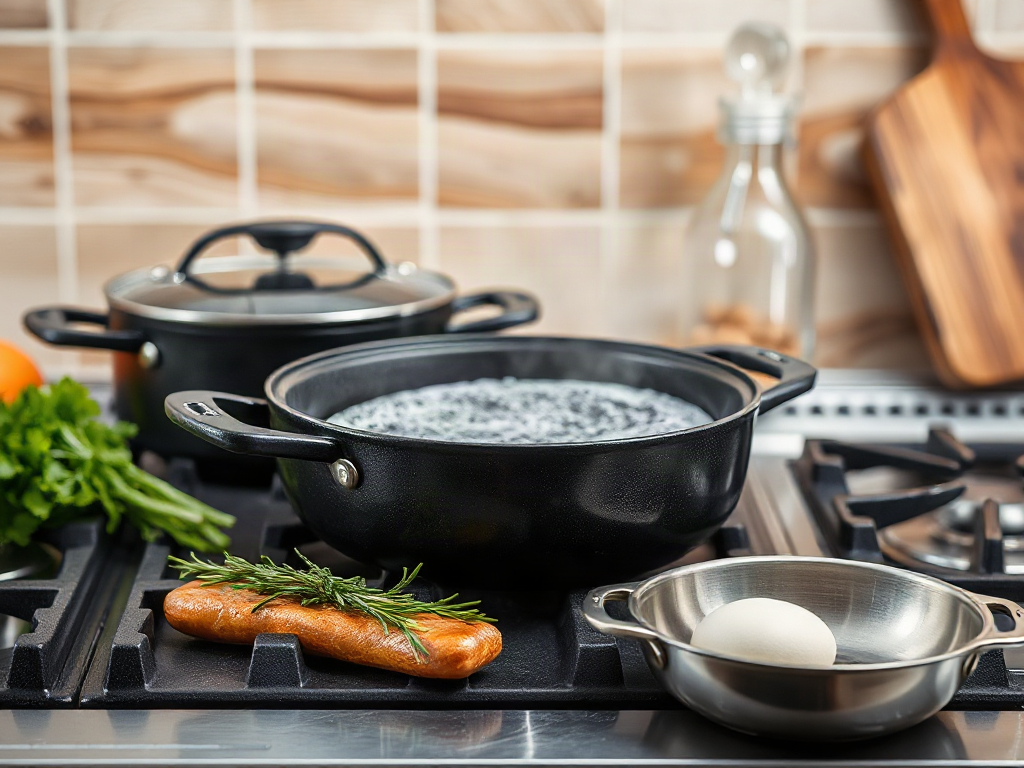
Matching cookware to stovetop type matters because pan material, base shape, burner contact, and magnetic compatibility determine how efficiently and evenly heat reaches food. Induction requires a flat, magnet-responsive base, while radiant electric glass performs best with smooth, stable pans and gas can accommodate more shapes but may create hot spots around thin cookware. A poor match can cause slow heating, uneven browning, unstable pans, wasted energy, or damage to a delicate cooktop surface. Check the appliance manual, test induction pieces with a magnet, inspect each base for warping, and choose pan diameter to suit the active cooking zone.
How Does Each Stovetop Transfer Heat?
A stovetop’s heating method determines which cookware characteristics have the greatest effect on performance. Gas flames heat the bottom and lower sides of a pan directly. Electric coil and radiant glass cooktops first heat an element, which then transfers heat into the pan through physical contact and radiant energy. Induction is different: an electromagnetic field interacts with a compatible pan base, generating heat in the cookware itself.
Some suggestions to consider!
Now retrieving an image set.
Caraway 12-Piece Non-Stick Ceramic Cookware Set | Pots, Pans, Lids and Kitchen Storage, PFAS and PFOA Free, Oven Safe Pan Set and Compatible with All Stovetops, Cream
$445.00 (as of October 20, 2026 19:17 GMT +00:00 - More infoProduct prices and availability are accurate as of the date/time indicated and are subject to change. Any price and availability information displayed on [relevant Amazon Site(s), as applicable] at the time of purchase will apply to the purchase of this product.)
Now retrieving an image set.
Cuisinart Chef's Classic Stainless Steel Pots and Pans Set, 11 pc, 77-11G | Induction cookware compatible with all stovetops, tri-ply base, cool-grip handles, nontoxic cookware set, oven safe 550°F
$170.00 (as of October 20, 2026 19:17 GMT +00:00 - More infoProduct prices and availability are accurate as of the date/time indicated and are subject to change. Any price and availability information displayed on [relevant Amazon Site(s), as applicable] at the time of purchase will apply to the purchase of this product.)
Now retrieving an image set.
SENSARTE 17 Piece Nonstick Detachable Handle Pots and Pans Set Black | Removable Handle Cookware Set, Induction Cookware Set with Removable Handle, Healthy Non Stick for RV, Dishwasher & Oven Safe
$79.99 (as of October 20, 2026 19:17 GMT +00:00 - More infoProduct prices and availability are accurate as of the date/time indicated and are subject to change. Any price and availability information displayed on [relevant Amazon Site(s), as applicable] at the time of purchase will apply to the purchase of this product.)Those mechanisms explain why the same skillet can behave differently after a kitchen upgrade. A slightly rounded or warped pan may remain usable over gas because flames reach uneven areas. On a glass or induction surface, the high points touch while gaps remain beneath the rest of the base. Heat transfer becomes less consistent, and the pan may rock when stirred. On induction, a severely uneven base may also reduce reliable detection by the cooking zone.
Gas offers broad material compatibility, but flexibility does not guarantee good results. A lightweight stainless steel pan can develop concentrated hot areas where the flame strikes, especially when the burner extends beyond its base. Multi-layer cookware with an aluminum or copper heat-spreading layer generally moderates those temperature differences. Bare copper and some aluminum pieces may conduct heat quickly on gas or conventional electric, but they will not operate on induction unless their bases include a suitable magnetic layer.
Radiant glass cooktops reward steady contact. A heavy, flat pan usually accepts heat more consistently than a thin pan that bows as its temperature changes. Responsiveness is slower than with an open flame because the glass and heating element retain heat after the control is lowered. Moving a sauce off the active zone may stop cooking faster than waiting for that zone to cool.
Induction responds quickly to control changes, but compatibility depends on construction rather than appearance. Cast iron and many magnetic stainless steel pans work, while aluminum, glass, ceramic, and copper require an induction-compatible base. A common mistake is assuming every stainless steel vessel is suitable. Stainless alloys and layered constructions vary, so the product marking or a simple magnet test is more dependable than color or weight.
The practical priority is to identify the heat-transfer method before comparing brands or finishes. Once that is known, base flatness, material response, and cooking-zone dimensions become useful selection criteria rather than incidental product details.
Which Cookware Works With Each Stovetop?
Compatibility has two levels: whether a pan can function on the appliance and whether it performs well there. A cast-iron skillet can work on gas, electric coil, radiant glass, and induction, yet its weight and textured exterior demand more careful handling on glass. Conversely, a round-bottom wok is excellent over a purpose-built gas wok burner but has too little contact area for most flat electric or induction zones.
| Stovetop | Strong cookware matches | Main limitation to check |
|---|---|---|
| Gas | Clad stainless steel, cast iron, carbon steel, copper, aluminum | Handles and sides can become hot when flames extend beyond the base |
| Electric coil | Flat stainless steel, aluminum, cast iron, enameled iron | Warped pans heat unevenly and may sit unstably on the coil |
| Radiant glass | Smooth, flat-bottomed clad stainless steel or manufacturer-approved pans | Rough bases, sliding, and dropped heavy cookware can mark or damage glass |
| Induction | Magnetic stainless steel, cast iron, compatible enameled iron | The base must be magnet-responsive and appropriately sized for zone detection |
For gas, prioritize heat distribution and burner fit. Thin cookware may heat quickly but can scorch sauces or produce patchy browning. Fully clad stainless steel or a substantial aluminum pan offers more even lateral heat movement. Carbon steel and cast iron are useful for searing, though both need enough preheating time to reduce temperature differences across the cooking surface.
Electric coils need a level base that rests securely across the element. Oversized cookware can extend far beyond the heated area, leaving the center much hotter than the edges. Small pans on large coils waste heat and can expose handles to excessive temperatures. Cookware should not be used to bridge two standard elements unless the appliance and vessel are specifically designed for that arrangement.
On radiant glass, smoothness and handling matter alongside thermal performance. Dragging cast iron, stoneware, or cookware with residue stuck underneath can scratch the surface. Sugary spills trapped beneath a hot pan may also be difficult to remove, so both the pan base and cooking zone should be clean and dry before heating. Consult the cooktop manual before using unusual materials or oversized canners because appliance limits differ.
For induction, hold a magnet against several parts of the base. A firm attraction suggests magnetic compatibility, although the appliance’s minimum pan size and detection requirements still apply. The induction symbol or manufacturer statement provides stronger confirmation. An induction interface disk may make some incompatible cookware usable, but it adds an extra heated layer, reduces the speed advantage, and can make temperature response less precise. Replacing a frequently used pan is often the more practical choice.
Why Do Pan Base and Size Matter?
The bottom of a pan is the working connection between the heat source and the food, so its geometry often matters more than its decorative finish. Flatness maximizes contact on coil, radiant, and induction surfaces. Diameter determines how closely the pan aligns with the active zone, while thickness and layered construction influence how quickly concentrated heat spreads outward.
Consider two frying pans used on a medium radiant element. A flat pan close to the element’s diameter receives heat across most of its base. A larger pan with a raised center may brown food in a ring while the middle cooks slowly. Raising the control can make the contacted areas hotter without correcting the gap. The better response is to use a flatter pan on a suitably sized zone rather than compensating with excessive heat.
Induction introduces an additional constraint: the magnetic portion of the base may be smaller than the pan’s visible footprint. A wide sauté pan can therefore work on an induction zone but heat most strongly over its magnetic core. Quality construction can spread that energy, although no pan can fully overcome a severe mismatch between a small active zone and a very broad cooking surface. Cooktop manuals commonly identify zone dimensions or minimum detectable pan sizes; those specifications should take priority over assumptions based on the circles printed on the glass.
Gas is less dependent on direct contact, but burner-to-pan sizing remains important. Flames that climb around the pan heat handles, discolor exterior walls, and send energy into the room rather than the food. For a small saucepan, use a burner that keeps the flame beneath the base. A large skillet placed over a tiny burner may develop a hot center and cool perimeter even when made from a conductive material.
Weight creates a tradeoff. Thick, heavy cookware tends to resist warping and hold heat steadily, which is useful for searing and braising. It responds more slowly when the control changes and may be awkward to lift from a smooth cooktop. Lightweight pans are easier to maneuver and can react quickly, but very thin bases are more likely to develop hot spots or distort. The best choice reflects both the appliance and the task: a responsive clad saucepan for temperature-sensitive sauces, for example, and a heavier skillet for sustained browning.
Signs of a sound match include stable seating, predictable preheating, and browning that follows the pan’s cooking surface rather than a narrow burner pattern. Rocking, repeated failure of an induction zone to recognize the pan, pronounced hot rings, or a base that spins on glass are signals to inspect flatness and sizing before blaming the recipe or appliance controls.
A Practical Cookware Compatibility Checklist
A reliable compatibility check begins with the appliance documentation and ends with a low-risk cooking test. Labels such as “all cooktops” are useful, but they do not address every issue involving minimum diameter, maximum vessel weight, surface texture, or specialized functions. The stovetop manual and cookware care instructions establish the limits for the specific products in the kitchen.
- Confirm the heat source. Distinguish radiant glass from induction even if both have smooth black surfaces. An induction zone generally does not heat ordinary nonmagnetic cookware, while radiant glass does.
- Verify material compatibility. For induction, look for the induction symbol or test the base with a magnet. For glass, check the appliance maker’s restrictions on rough, oversized, or unusually heavy vessels.
- Inspect the complete base. Set the cool pan on a flat counter and press gently around the rim. Rocking, spinning, bulges, burnt residue, or sharp edges can interfere with contact or surface care.
- Compare base diameter with the cooking zone. Measure the area that actually contacts the stovetop, not the flared rim at the top of the pan.
- Run a controlled test. Heat a modest amount of water at a medium setting while remaining nearby. Watch for stable detection, unusual rocking, concentrated boiling patterns, excessive noise, or odors from residue.
The water test is not a precise laboratory measure of heat distribution, but it can reveal obvious problems without risking an expensive ingredient. On induction, faint humming or clicking can be normal for some pan-and-appliance combinations. Violent vibration, intermittent recognition, or movement across the surface deserves attention. Reposition the pan, try a correctly sized zone, and compare it with another confirmed-compatible vessel. Persistent abnormal behavior should be addressed through the manufacturer’s instructions rather than improvised modifications.
When buying cookware, take the base measurement and appliance requirements with you. A pan advertised by its top diameter may have a substantially smaller contact area. Examine whether the bottom is continuous and smooth, whether an induction plate reaches near the edges, and whether the vessel’s loaded weight will be manageable. Sets can create false economy if several pieces are poorly sized for the available zones; selecting individual pans around routine meals may produce a more functional collection.
Avoid assuming an adapter, heat diffuser, or protective mat is universally safe. Such accessories can change temperature behavior, trap heat, or conflict with appliance instructions. Use only products the cooktop manufacturer permits. Similarly, do not slide cookware merely because the base appears smooth; grains of salt or hardened residue can sit between two otherwise clean-looking surfaces.
Successful matching is visible in daily use: controls produce repeatable changes, food cooks across the intended area, and the vessel remains stable without mistreating the cooktop. If the pan needs unusually high settings, cooks in a narrow ring, or repeatedly loses induction detection, reassess compatibility before replacing the appliance.
Frequently Asked Questions
Can all cookware be used on a gas stove?
Gas accepts most heat-safe cookware materials, but pan stability, handle exposure, and flame size still matter. Keep flames beneath the base and use a stable support for unusually small or rounded vessels.
How can I tell whether a pan works on induction?
Check for an induction-compatible marking and place a magnet against the base. Strong attraction is a useful screening test, but the pan must also meet the cooktop’s size and shape requirements.
Is cast iron safe on a glass cooktop?
It may be suitable when the appliance manual permits it. Lift rather than slide the pan, keep its base clean, avoid impact, and consider whether its weight is manageable for the surface.
Why does a pan heat unevenly on an electric stove?
A warped base, mismatched element size, thin construction, or poor contact can concentrate heat. Test the pan for rocking and compare its contact diameter with the active element.
Do induction adapter plates make every pan compatible?
An approved adapter can transfer heat to some nonmagnetic cookware, but it usually slows response and reduces efficiency. Confirm that the cooktop manufacturer allows one before use.
Conclusion
Cookware selection should follow the way the stovetop creates and transfers heat. Begin by confirming whether a smooth surface is radiant or induction, then verify material compatibility, base flatness, contact diameter, and any restrictions in the appliance manual. Gas permits the widest range of materials, but correct burner sizing and heat distribution still affect control. Electric and glass surfaces place greater emphasis on stable contact, while induction adds magnetic and pan-detection requirements.
Inspect the pans already in the kitchen before buying replacements. Retain pieces that sit securely, heat predictably, and fit the available zones; reconsider those that rock, create severe hot rings, damage the surface, or lose induction recognition. Matching individual workhorse pans to common tasks is usually more useful than purchasing a large set based only on its material label.