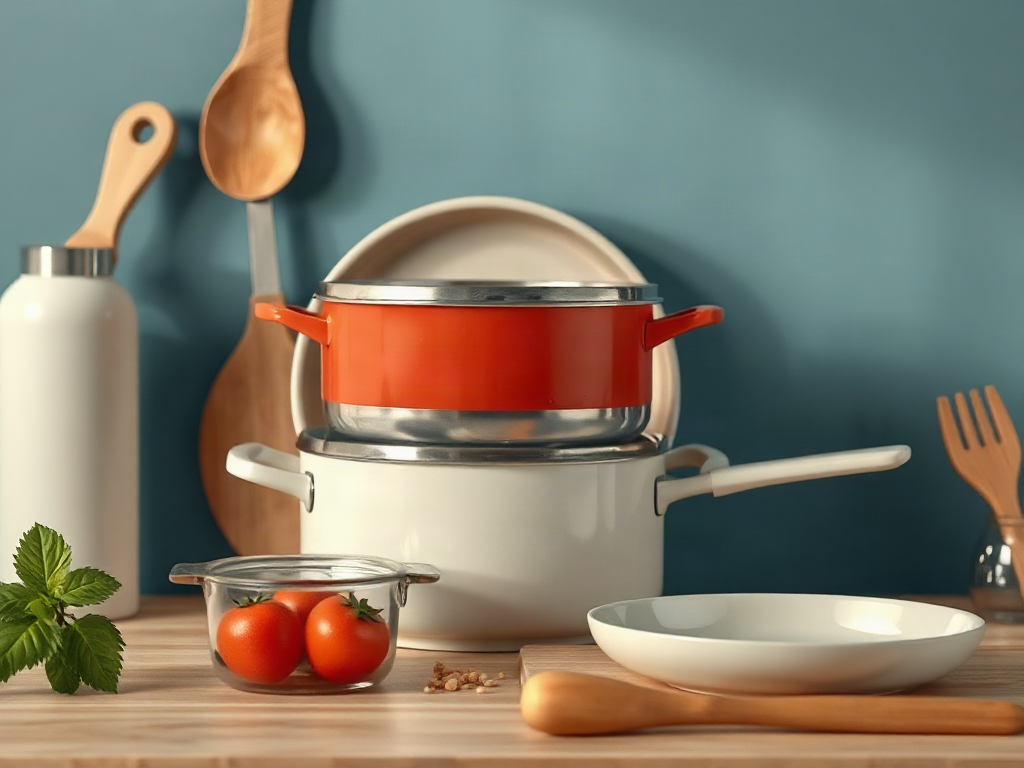
Recognize cookware that is easy to store by checking whether the pieces nest without wobbling, handles align within a compact footprint, and lids stack or mount separately without sliding. Measure the cabinet or drawer first, then compare that space with the set’s nested height, widest diameter, and handle length rather than relying on piece count. Removable handles, low-profile knobs, shared lids, and graduated pan sizes usually reduce wasted space. Avoid sets whose steep rims, fixed opposing handles, or mismatched shapes create unstable stacks.
Measure the Storage Space Before Judging the Cookware
Storage-friendly cookware must fit the specific cabinet, drawer, shelf, or rack where it will live. A set that looks compact in a product photo can still be impractical if its longest handle blocks a cabinet door, its stacked height exceeds a drawer’s clearance, or its largest pot consumes the entire usable shelf. Dimensions matter more than the number of pieces printed on the box.
Some suggestions to consider!
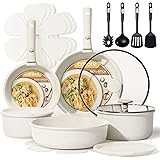


CAROTE 19pcs Pots and Pans Set Non Stick, Detachable Handle Cookware, White | Induction Compatible, Dishwasher & Oven Safe, Kitchen Organization, Cooking Set for Camping/RV/Traveling, House Warming Gift
$54.99 (as of October 25, 2026 19:20 GMT +00:00 - More infoProduct prices and availability are accurate as of the date/time indicated and are subject to change. Any price and availability information displayed on [relevant Amazon Site(s), as applicable] at the time of purchase will apply to the purchase of this product.)
Now retrieving an image set.
Calphalon Classic Stainless Steel Cookware Set, 10-Piece, Impact-Bonded Aluminum Base, Stay-Cool Handles, Oven Safe 450F, Silver
$132.99 (as of October 25, 2026 19:20 GMT +00:00 - More infoProduct prices and availability are accurate as of the date/time indicated and are subject to change. Any price and availability information displayed on [relevant Amazon Site(s), as applicable] at the time of purchase will apply to the purchase of this product.)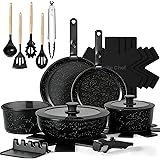
Now retrieving an image set.
Umite Chef 21Pcs Pots and Pans Set Non Stick, Nonstick Ceramic Cookware Sets Detachable Handle, Non Toxic Healthy Induction Cookware, Kitchen Cooking Set, with Frying Pans Set, Dishwasher/Oven Safe
$57.99 (as of October 25, 2026 19:20 GMT +00:00 - More infoProduct prices and availability are accurate as of the date/time indicated and are subject to change. Any price and availability information displayed on [relevant Amazon Site(s), as applicable] at the time of purchase will apply to the purchase of this product.)Measure the internal width, depth, and height of the intended space. Account for hinges, shelf supports, drawer sides, plumbing, and door frames that narrow the opening. The opening itself may be smaller than the interior, so a wide skillet that would fit inside a cabinet might not pass through the door at the required angle. For a drawer, measure from the drawer bottom to the lowest obstruction above it rather than to the top of the counter.
Next, decide how the cookware will enter and leave the space. Deep lower cabinets favor short nested stacks that can be lifted together or separated from the top. Shallow drawers work better with pans laid in graduated stacks, provided their handles point in one direction. A narrow cabinet may suit vertically stored skillets but handle a tall stockpot poorly. Storage is therefore a relationship between cookware geometry and the direction of access, not simply total cabinet volume.
A practical measurement check should record four limits:
- Maximum base diameter: the widest vessel that can sit flat without crowding hinges or neighboring items.
- Maximum handle span: the distance from the far rim to the end of the longest fixed handle.
- Available stacked height: including lid knobs, protectors, and any organizer beneath the stack.
- Clear opening: the usable door or drawer opening through which every piece must pass.
The common mistake is measuring an empty shelf while ignoring retrieval. If the bottom skillet requires removing a stack of heavy Dutch ovens, the cookware technically fits but is not conveniently stored. Leave enough room to grip and lift frequently used pieces without scraping them against a shelf. A sign that the plan works is that each everyday pan can be removed in one or two motions; repeated unloading of unrelated pieces signals a poor match.
What Makes Cookware Nest Well?
Good nesting depends on graduated diameters, compatible wall angles, and stable points of contact. Each smaller vessel should settle partly inside the next larger one without becoming wedged or balancing on a rim. The resulting stack should rise gradually rather than adding nearly the full height of every pan.
Look at the sides of the pots and pans. Slightly sloped walls generally allow deeper nesting than straight vertical walls of similar diameter. Rolled rims, pouring spouts, and flared edges can interrupt that fit, especially when multiple pieces have nearly identical dimensions. Two pans described as different sizes may not nest usefully if their bases are almost equal or if the smaller pan’s rim rests on the larger pan’s rim.
Stability is just as important as compactness. A skillet that rocks inside a saucepan can place concentrated pressure on an interior finish and make the stack awkward to lift. Bare stainless-steel pieces tolerate contact better than nonstick or enameled surfaces, but hard rims and rough bases can still leave marks. Thin pan protectors, clean dish towels, or manufacturer-supplied pads reduce direct contact, although their thickness must be included when estimating the final stack height.
Shape consistency usually beats nominal piece count. A coordinated group of 8-, 10-, and 12-inch skillets often occupies less space than three pans with unrelated wall profiles and protruding helper handles. Similarly, saucepans designed around graduated circumferences may form one stable column, while a saucepan, saucier, and small Dutch oven of comparable width may refuse to nest despite serving different cooking purposes.
Test a nested stack by gently pressing near opposite rims. The pieces should remain centered without tipping sharply or locking together. Then lift out the middle item. It should release without twisting, pulling on a coating, or disturbing every piece above it. Perfectly tight nesting is not desirable if vacuum-like resistance, trapped handles, or metal-on-metal friction makes separation difficult. The best arrangement saves vertical space while preserving access and protecting cooking surfaces.
How Do Handles and Lids Affect Storage?
Handles and lids often determine the true footprint after the vessels themselves have been nested. Long fixed handles extend beyond cabinet shelves, while helper handles can collide with neighboring pieces and prevent pans from settling deeply. Lid knobs add height, and mismatched lid diameters create unstable piles that use more room than the pots.
Fixed handles are convenient during cooking because there is nothing to attach, lose, or check before lifting a hot pan. For storage, aligned handles are the critical feature. When every skillet handle can point in the same direction without the pans rotating or tilting, the set occupies a narrow, predictable lane. Handles that rise steeply from the rim may increase stacked height; nearly horizontal handles need more depth. Neither design is automatically better—the cabinet dimensions decide which constraint matters.
Removable handles can turn several vessels into compact, bowl-like forms. They are particularly useful in drawers, recreational vehicles, and other confined kitchens. The tradeoff is operational: the handle needs its own accessible location, must connect securely according to its instructions, and may not suit every high-heat or oven use. A detachable mechanism also adds parts that require cleaning and inspection. Compact storage should not be treated as permission to lift a loaded hot vessel with a poorly seated handle.
Lids deserve a separate plan. Flat lids with folding or low-profile knobs stack more efficiently than domed lids, but a dome may provide useful cooking clearance and visibility. Shared lids reduce the number stored when one diameter fits several vessels. Before counting that as a benefit, confirm that each shared lid seats properly and does not merely balance loosely on different rims.
Vertical lid organizers work well when cabinet height is available and lids have rims that sit securely in slots. A rail or door-mounted holder can free shelf space, but only if the cabinet door closes without the lids striking pan handles. Stacking glass lids directly beneath heavy cookware is a poor compromise because concentrated loads and shifting metal increase the chance of chips or breakage. Easy-to-store cookware has an obvious, protected location for every lid rather than leaving lids as an afterthought.
How Can You Test the Storage Design Before Buying?
A reliable storage test uses complete dimensions and the intended arrangement, not packaging claims such as “space-saving.” Product listings may show vessels nested without lids, protectors, handles, or the largest accessory. Ask for or verify the nested dimensions of the usable configuration. If only individual measurements are available, map them against the storage space and allow extra clearance for lifting.
When examining cookware in person, assemble the stack yourself if permitted. Check whether handles align naturally, whether each base sits below the next rim, and whether the stack remains level. Remove the piece you expect to use most often. If reaching it requires lifting several heavy items or placing loose lids on the counter, the arrangement may become frustrating during daily cooking.
For an online purchase, compare side-view images, rim profiles, handle angles, and the number of distinct lid sizes. Customer photos can reveal the stored configuration more accurately than a staged image, but verify that they show the same model and piece combination. Published individual dimensions are more dependable than visual estimates. A return policy can matter when the manufacturer does not provide nested measurements, because small differences in handles or rims may only become apparent in the actual cabinet.
Use this compact pre-purchase test:
- Sketch the shelf or drawer and mark its obstructed areas.
- Add the largest vessel using its full rim-to-handle span.
- Estimate nested height with lids and surface protectors included.
- Assign a secure location to detachable handles and every lid.
- Simulate removal of the two pans used most frequently.
Be cautious when a large advertised set includes utensils, steamer inserts, or several lids in its piece count. Those components may be useful, but each needs storage and may not join the main nest. A smaller set of compatible vessels can occupy less space and serve a household better than a larger package of overlapping sizes. The design is succeeding when the full collection fits in its assigned area, remains stable, and allows routine pieces to be retrieved without rearranging the kitchen.
Balance Compactness Against Cooking Performance
Maximum nesting should not override the cooking jobs the cookware must perform. Strongly sloped sides help skillets fit together but reduce flat cooking area compared with straighter walls of the same rim diameter. Very short handles save depth yet may offer less leverage with a heavy, full pan. Flat lids store neatly, while domed lids provide more headroom for bulky food.
Material and construction also change the storage decision. Heavy cast iron can nest, but a tall pile may be difficult to lift and can overload a light drawer or shelf. Enameled and nonstick interiors benefit from separators, which add height and another step during retrieval. Stainless-steel cookware is often less vulnerable to superficial contact, although careless stacking can still scratch polished surfaces or trap moisture. Cookware should be clean and dry before nesting so enclosed spaces do not hold residue or dampness.
Frequency of use should shape the layout. A household that uses one skillet every morning gains little from placing it beneath a stockpot used monthly. Store the daily skillet at the top, on a vertical rack, or in a separate shallow drawer even if that arrangement is not the smallest possible. Reserve deep nesting for pieces used together or accessed less often. Convenience is measured by repeatable access, not by creating the tightest display.
Modular buying can outperform a preselected set in a small kitchen. Start with the pan types actually used, then choose graduated sizes with compatible handles and lids. The opposing approach—a fully matched set—may deliver more consistent nesting, but it can include redundant pieces. Check stovetop compatibility, oven limits, weight, lid fit, and cooking surface before accepting a storage advantage.
A sensible priority order is cooking suitability first, safe handling second, surface protection third, and compactness fourth. Storage features add value only when the cookware remains practical at the stove. If the stack repeatedly jams, scratches finishes, conceals the everyday pan, or feels unsafe to lift, revise the arrangement or replace the least compatible piece rather than forcing the complete collection into one column.
Frequently Asked Questions
Is nesting cookware always easier to store?
No. Nesting saves volume only when the stack is stable, separates easily, and keeps frequently used pieces accessible. A tight or very heavy stack can be less convenient than a rack.
Should lids be stored on their pots?
Usually not when space is limited. Storing lids vertically or in a protected stack often allows pots to nest more deeply, provided every lid has a secure assigned position.
Are removable handles better for small kitchens?
They can reduce drawer and cabinet space substantially, but the attachment must be easy to access, correctly seated, and suitable for the intended cooking and oven use.
How should nonstick pans be stacked?
Place a clean, soft protector between pans and avoid letting rough bases or metal rims bear directly on coated interiors. Include protector thickness in the storage measurement.
Is a cookware set more space-efficient than individual pans?
A set may nest more consistently, but only if its sizes, handles, and lids were designed to work together. Carefully selected individual pans can be more efficient when they avoid unused or redundant pieces.
Conclusion
Judge storage fit with a tape measure and a retrieval test rather than a piece count or a space-saving label. The strongest candidates use graduated shapes, stable contact points, aligned or removable handles, and a clear lid-storage plan. Include protectors in the final dimensions, especially for nonstick or enameled surfaces, and avoid building a stack that is too heavy to handle safely.
Before buying, map the largest rim-to-handle span and complete nested height inside the actual cabinet or drawer. Then check whether the most-used pan can come out without unloading everything else. Choose cooking performance and secure handling over a marginal reduction in cabinet volume. If a collection already fits poorly, separate daily pans from occasional vessels, move lids to an organizer, and remove redundant pieces before replacing the entire set.