Identify cookware that promotes even cooking by checking its base thickness, material construction, flatness, and response to a controlled heat test. A thick, level base usually spreads energy more consistently than a thin pan, while aluminum or copper layers can improve heat transfer when properly integrated into stainless steel. Look for a cooking surface that sits flat, matches the burner, and avoids rapid hot spots during preheating. Test an empty pan briefly over moderate heat, then add a small amount of water or batter; uneven sizzling, early browning in one area, or a visibly warped base signals inconsistent performance. Match the pan’s design to the foods you prepare most often.
Read the Base and Construction
The base is the first place to look when judging whether cookware will heat evenly. A pan that is flat, substantial, and firmly constructed is more likely to distribute energy across its cooking surface than one with a thin, flexible bottom. Thickness alone does not guarantee excellent results, but it gives the metal more thermal mass, which can reduce abrupt temperature swings when cold ingredients enter the pan.
Inspect the underside on a level counter. A quality base should not rock, bow upward, or show a gap between its main disk and the surrounding body. A fully clad pan carries heat-conductive layers up the sides, whereas a disk-bottom pan concentrates its main distribution layer beneath the food. Neither design is automatically wrong: clad construction may be useful for sautéing and sauce work, while a well-made disk base can perform effectively for simmering in a stable saucepan.
Some suggestions to consider!

Now retrieving an image set.
SODAY Pots and Pans Set Non Stick, 12Pcs Black Granite Induction Cookware | PFAS/PFOA/PFOS Free, Healthy Nonstick Kitchen Cookware Sets, Includes Fry Pans & Saucepans.
$79.99 (as of September 7, 2026 18:36 GMT +00:00 - More infoProduct prices and availability are accurate as of the date/time indicated and are subject to change. Any price and availability information displayed on [relevant Amazon Site(s), as applicable] at the time of purchase will apply to the purchase of this product.)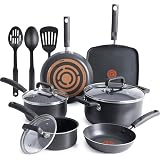
Now retrieving an image set.
T-Fal Signature Nonstick Pots and Pans Set 12 Piece, Oven Broiler Safe 350F, Kitchen Cookware Set w/Fry Pans, Saucepans, Saute Pan, Dutch Oven, Griddle, Kitchen, Home, Dishwasher Safe, Black
$109.99 (as of September 7, 2026 18:36 GMT +00:00 - More infoProduct prices and availability are accurate as of the date/time indicated and are subject to change. Any price and availability information displayed on [relevant Amazon Site(s), as applicable] at the time of purchase will apply to the purchase of this product.)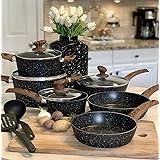
Now retrieving an image set.
Kitchen Academy Pots and Pans Set Non Stick, 12pcs Induction Cookware | Nonstick Kitchen Cookware Set, Black Granite Cooking Pans, PFOS & PFOA Free, Easy Food Release, Fast & Even Heating
$139.99 (as of September 7, 2026 18:36 GMT +00:00 - More infoProduct prices and availability are accurate as of the date/time indicated and are subject to change. Any price and availability information displayed on [relevant Amazon Site(s), as applicable] at the time of purchase will apply to the purchase of this product.)Construction details matter most when the pan is used on a burner smaller than its diameter. A narrow heat source can create a hot circle in the middle. A conductive layer that extends across the base helps spread that energy outward, but an oversized pan may still cook slowly near the edges. Check whether the stated base diameter reasonably matches your usual burner before treating a heavy pan as an all-purpose solution.
A common mistake is equating weight with even heating. A heavy cast-iron skillet can retain heat well yet take longer to warm and may develop a strong center-to-edge difference on a small burner. Conversely, a lighter aluminum pan may respond quickly and distribute heat effectively, but it can lose temperature faster when loaded with food. Prioritize a flat base and suitable dimensions before using heft as a shortcut.
For more context on choosing among pan styles, review how to identify cookware that promotes even cooking alongside the manufacturer’s construction description. Words such as “encapsulated base,” “tri-ply,” or “multi-layer” are useful only when they explain where the conductive material sits and how it is bonded.
Compare Materials and Heat Response
Material determines how quickly a pan absorbs and moves heat, so the best choice depends on whether you value rapid adjustment, heat retention, or a balance of both. Copper and aluminum transfer heat readily, allowing temperature changes to travel across the surface quickly. Stainless steel is durable and comparatively responsive to cleaning, but stainless steel alone is less conductive than aluminum or copper, which is why many stainless pans use an internal conductive core.
Clad cookware combines metals in layers. A stainless exterior may surround an aluminum core, or a pan may include copper for faster thermal response. The practical question is not simply how many layers are advertised; ask whether the conductive layer covers the full cooking area and, for your tasks, the sidewalls. A saucepan used for reductions benefits from responsive sidewalls, while a skillet used mainly for searing may be judged more heavily by its base and thermal stability.
Cast iron illustrates the difference between evenness and responsiveness. Once thoroughly preheated, it can provide a steady cooking platform for steaks, cornbread, or pancakes. It is slower to heat and slower to cool than aluminum, so raising or lowering the burner will not produce an immediate change. Thin carbon steel reacts more quickly but may show stronger temperature variation until it is properly preheated.
Nonstick coatings add another consideration. A coating may make delicate foods easier to release, but it does not correct a warped or poorly distributed base beneath it. Eggs can appear to cook smoothly because they are thin and move easily, while a pancake may reveal uneven browning more clearly. Treat the coating as a surface feature, not proof of uniform heat.
Match material response to the food. Quick sautéing, vegetables, and pan sauces often benefit from a responsive conductive core. Long braises and shallow frying may favor greater heat retention, provided the pan’s dimensions fit the burner. A useful companion resource is how to identify cookware that promotes even cooking when comparing fast-response aluminum with slower, heavier iron.
Use Practical Tests for Hot Spots
Simple cooking tests reveal more than a polished product description. If you already own the pan, heat it gradually on a burner that is close to the base diameter. A brief water test can show whether droplets skate, evaporate immediately in one location, or remain cool near the rim. The result is affected by temperature and cleanliness, so use it as a comparison rather than a laboratory measurement.
A batter test is more useful for seeing browning patterns. Preheat a skillet at moderate power, add a small, consistent amount of pancake batter, and observe the color as it cooks. A dark ring or an early-browning center suggests a temperature gradient. Repeat the test after adjusting burner size and heat level; if the pattern improves substantially, the issue may be a mismatch between pan and burner rather than defective construction.
For sauté pans and frying pans, a thin film of oil can provide another visual clue. Add oil after preheating and watch whether it thins evenly or races toward a low point. Oil movement can indicate a warped base, while food that browns in isolated patches points toward uneven surface temperature. Do not overheat an empty nonstick pan during testing, and follow the care instructions for any coated surface.
Use a controlled comparison when shopping in a store. Place the pan on a flat display surface, check for rocking, examine the base for dents, and compare the advertised cooking diameter with your burner. You cannot fully verify heat distribution without using the pan, but you can eliminate obvious structural warning signs. Online, prioritize clear specifications about core material, base coverage, flatness, and compatibility rather than vague claims such as “professional quality.”
One misleading assumption is that a pan must heat identically at every point. Burner geometry, food quantity, stirring, pan position, and preheating all influence results. The practical goal is predictable enough heating that ordinary techniques—turning the pan, stirring, or lowering the flame—can manage the remaining variation.
Match Pan Design to the Cooking Task
Even cooking is task-specific. A wide skillet gives vegetables and meat room to contact the surface without crowding, but its outer edge may remain cooler on a small burner. A smaller saucepan can heat its contents more uniformly when the base closely matches the burner, yet its narrow shape may make evaporation slower. Shape, depth, and surface area therefore belong in the same decision as material.
For pancakes, crepes, and grilled sandwiches, a broad, flat surface with modest temperature variation is more useful than a very deep vessel. For rice, custard, and thick sauces, a heavy base and responsive control help prevent scorching at the bottom while the upper layer remains underheated. A sauté pan with sloped sides encourages evaporation and tossing; a straight-sided pan holds liquid but may require more stirring around the perimeter.
Consider a weeknight cook who uses an electric coil burner and prepares stir-fried vegetables. A very large thin skillet may seem attractive because it offers space, but the food at the center can brown before the edge becomes hot. A medium-width pan with a conductive layered base may provide a better compromise. Someone cooking stews on a broad induction zone may prefer a heavy vessel that retains heat, even though it will respond more slowly to changes in power.
Induction adds a compatibility check: the magnetic base must make good contact with the cooking zone, and the pan should not be substantially smaller or larger than the active area. Gas burners heat the underside and sides differently, so a pan with conductive sidewalls may show different behavior than the same pan on a flat electric surface. “Even” never means identical across every stovetop.
Choose the pan that fits the food volume, burner, and control style you actually use. A versatile set with several moderate sizes may outperform one oversized premium skillet if the latter routinely extends beyond the effective heat zone.
Avoid Misleading Buying Signals
Marketing language can obscure the features that affect cooking consistency. A shiny finish, a familiar brand, or a high price does not establish uniform heating. Look for construction information, base measurements, material layers, weight distribution, and a clear warranty or return policy. A return option is especially useful because real cooking exposes behavior that photographs and packaging cannot.
Read reviews for repeatable observations rather than isolated praise. Comments about a pan scorching in the center, taking unusually long to preheat, or warping after ordinary use are more diagnostic than general statements that it “feels premium.” Separate handling complaints from thermal complaints: an uncomfortable handle may be inconvenient, but it does not necessarily indicate poor heat distribution.
Do not ignore maintenance. Sudden cooling of a very hot pan can contribute to warping, and repeatedly heating an empty coated pan can damage its surface. Use the recommended burner setting, avoid sliding a pan across rough grates, and store it so the base is not forced out of shape. A well-designed pan can still perform poorly after distortion.
Use this compact buying check before committing:
- Confirm that the base sits flat without rocking.
- Identify the conductive material and whether it covers the full cooking area.
- Compare the pan’s base diameter with the burner or induction zone.
- Choose responsiveness or heat retention according to the foods you cook.
- Check care instructions, warranty terms, and return conditions.
The strongest choice is the one that offers predictable results under your actual constraints, not the one with the most impressive specification list. For a final comparison, use how to identify cookware that promotes even cooking as a practical checklist while weighing construction, task, and stovetop compatibility.
Manufacturer documentation for a specific pan can clarify its core materials, stovetop compatibility, temperature limits, and care requirements. University extension cooking resources and recognized consumer-testing publications can also help readers compare heat response and pan construction without relying solely on promotional claims.
Frequently Asked Questions
Does heavier cookware always cook more evenly?
No. Weight can improve heat retention, but a heavy pan may still have a concentrated hot spot or poor burner fit. Flatness, conductive layers, and dimensions matter as well.
Which material is best for even cooking?
There is no universal winner. Aluminum or copper cores usually respond quickly, while cast iron retains heat longer. A well-constructed layered pan often balances both properties.
How can I check a pan for hot spots at home?
Use a controlled water, oil, or pancake-batter test over moderate heat and look for isolated sizzling, uneven spreading, or patchy browning. Repeat with the correct burner size.
Does pan size affect heat distribution?
Yes. A pan much wider than the burner may have a cooler perimeter, while a small pan over a large burner can overheat at the center. Match the base to the heat source.
Can a nonstick coating make heating more even?
No. A coating affects release and cleanup, not the underlying thermal design. Inspect the base and construction separately, and avoid overheating the empty pan.
Further Reading
Authoritative Sources
- Academy of Nutrition and Dietetics
eatright.orgProfessional nutrition guidance, healthy eating resources, and practical dietitian-reviewed advice.
- U.S. Department of Agriculture
usda.govOfficial food, nutrition, agriculture, and consumer guidance from the USDA.
- NIH Office of Dietary Supplements
ods.od.nih.govResearch-based fact sheets on nutrients, supplements, dietary intake, and safety considerations.
- International Society of Sports Nutrition
sportsnutritionsociety.orgEvidence-informed sports nutrition resources and position stands for active people and athletes.
Conclusion
Reliable cooking starts with judging the structure beneath the food. Check that the base is flat, identify whether aluminum or copper supports heat transfer, and compare the pan’s dimensions with your burner. Then test performance with a controlled ingredient such as batter or a small film of oil instead of trusting weight, finish, or price as proof of quality. Choose faster response for foods that need frequent temperature changes and stronger retention for searing or long cooking, while recognizing that each option has tradeoffs. A pan that fits your stovetop, cooking volume, and preferred foods will usually be more useful than an oversized or heavily marketed alternative. Record where browning occurs during your first few uses, adjust burner power, and return the cookware if uneven heating remains excessive.